Showing posts with label cults. Show all posts

Saturday, 20 March 2010

McGoohan and the Rehearsed Mind from Moby Dick: It was the whiteness of the whale that above all things appalled me.

What is it that in the Albino man so peculiarly repels and often shocks the eye, as that sometimes he is loathed by his own kith and kin! It is that whiteness which invests him, a thing expressed by the name he bears. The Albino is as well made as other men- has no substantive deformity- and yet this mere aspect of all-pervading whiteness makes him more strangely hideous than the ugliest abortion. Why should this be so? - Herman Melvillle - Chapter 42 - Moby Dick

In my last Blog I mentioned the observations of the first academic *students* of The Prisoner and their bemusement about how so much of the series seemed to have occurred *by accident* or *by chance*. The story of the genesis of Rover seemed so absurd to the Cult Society that arose in Britain, that they declined to believe the story McGoohan told. However the coincidences of Rover are both mundane and elucidatory in equal measure. Perhaps most intriguing is the fact that the original plan was to have a domed wheeled machine (British fans for some years maintained this machine never existed and was just another tall tale by McGoohan). The drift from an egg-shaped machine to an amorphous egg that in turn lent itself to a mimickry of the bubbles from a then very fashionable lava-lamp is a progression that happened by chance, yet on the other hand it is easy to see the *train of thought* by imaginative minds. The allegorical ideas McGoohan was keen to employ are in some form perhaps first demonstrated by this happenstance. Was he also carrying the notions of Moby Dick's baffling chapter, "The Whiteness of the Whale", from which my prefacing quote stems ? These comments by a fellow of the Blogosphere might strike a coincidental chord in anyone who has read some analyses of the nature of Rover, from The Prisoner :
http://ladderonwheels.blogspot.com/2009/11/whiteness-of-whale.html
If you ever read Herman Melville’s Moby-Dick for a class and want to make your teacher very, very angry, try to steer every conversation around to the “meaning” of the white whale itself. Your teacher won’t appreciate it, but you’ll just be following the early trends of Melville critics, for whom the whale absolutely must have represented some huge secret to the meaning of life. Is it God? Evil? Purity? Humanity? Sin? Sexuality? You name it, and someone’s proffered it as the secret meaning of the novel.

Mere coincidence? The story-book from The Girl Who was Death has another....

Anyhow, the mechanical Rover was seemingly abandoned by the owner of Everyman without a second glance - the *new* Rover gave him far more allegorical scope and he grasped the chance. Many years later Patrick McGoohan would explain to an interviewer:
I don't know how to plan. For The Prisoner, for example.....When we discussed a design, I told him what I had in mind and he translated it onto paper.......... We understood each other marvellously. And that's the best way to work. If there's enthusiasm and the team feels it's being directed by someone who knows what he wants, then all that enthusiasm goes into good work.

At least one memoir from one of the colleagues of McGoohan's recalls McGoohan being enamoured of the book The Outsider, by Albert Camus. However, McGoohan himself, when questioned about books such as The Glass Bead Game responded that he didn't read "that sort of stuff". Is it mere coincidence that a book called The Outsider by Colin Wilson - classed as one of the original Angry Young Men of 1950's British Theatre - had been a best-selling book in England, and was something of a potted biographical study about the "men in isolation" throughout history? McGoohan did admit to liking biographies. Was the title on the spine of a book misunderstood by this coincidence of titles? If you have never heard of this other Outsider, one of my earlier blogs deals with it here: http://numbersixwasinnocent.blogspot.com/2009/10/mcgoohan-on-my-mind-episode-18-angry.html

The Glass Bead Game is the source of another cult myth. Prisoner writers have claimed that the *hero* of this book was named Joesph Serf, but in fact he wasn't. The character was actually named Josef Knecht. They often just make stuff up.


The name Joseph Serf is evidently a play on the self-mockery of McGoohan himself. Growing up as the eldest brother of several younger sisters one can imagine the adolescent sighing wearily to his mother (who he remarked liked to call him Patrick-Joseph), "It's okay Ma, Joe Serf will do it...", when yet another heavy chore needed to be done by one of the children.

Another coincidence has become muddled in the interpretations of John Drake transmogrifying into Number Six. In America, the title-song famously reads:
Secret Agent Man.
Secret Agent Man.
They've given you a number.
And taken away your name.

Some observers have since wondered if this ditty even was part of the inspiration for McGoohan's later use of the idea of a man with no name. It's quite possible this coincidence fed into his train of thought - he was certainly aware of the song, as recorded in the article about he and Peter Falk from 1965, in my previous Blog to this one.

So why did PF Sloan write such a line for Johnny Rivers to sing? Another coincidence might explain it. In 1965, when the hour-long adventures of John Drake were sold to CBS, the pilot episode was to be Battle of the Cameras. It would make sense that in order to help Sloan to figure out a theme-song, CBS would give him a preview of the show itself to watch, to get a sense of the style and characters. In the opening scene of this US debut episode an agent is introduced to his superior and identifies himself as Agent 1056. One can imagine this numeralisation adding to the resonances already of Agent 007 and sticking in the song-writers mind - the agents in Danger Man were normally spoken of by name, so this is a striking coincidence, and an interesting example of how effect and cause can sometimes be very difficult to unravel. Was the number 7 also deliberately made absent in The Prisoner by McGoohan as some small injoke about the most famous secret agent's number? It made it ironic that Number Six drove a Lotus 7 of course, too.

Was it mere coincidence that the first character Number Six speaks to in the village was Ralph Smart's sister, Patsy? http://numbersixwasinnocent.blogspot.com/2009/06/secret-agents-ducks-drakes-smart-people.html I can imagine the blog reader is beginning to find all these questions are a burden, but perhaps by asking the questions I also supply an occasional answer that makes more sense than the cult stories about McGoohan, Royalties and the Smarts.

One of the principal cult leaders released a careerography of Patrick McGoohan a year or two ago. He touches here and there on some of the contested elements of the genesis of The Prisoner. Privy to the unpublished but widely whispered sayings of George Markstein, this writer [sic] quotes the Script Editor on page 110: "I decided to call him Number Six because it's high enough to make him important and low enough for him to get pushed around" A reasonable enough comment, and possibly one I could have made up myself, but from the man who claimed to have researched a mysterious Scottish location from WW2, it seems curiously bland and inconsequential in view of recently published WW2 history. "One answer was to be found at the eighteenth century Inverlair Lodge, nicknamed 'Number 6 Special Workshop School' in Scotland" http://europeanhistory.about.com/b/2008/09/12/britains-failed-ww2-spies.htm

It seems curious that if Markstein had indeed secretly researched Inverlair, as he claimed many years later, that he had not noticed the curious coincidence of the number allocated to the prisoner himself and the name of the establishment. It is of course my contention that Markstein made these decade-later post-hoc claims merely to accumulate kudos amongst gullible prisoner fans, who applied very little, if any, study to the facts behind his stories. I had to grin at another passage on that same page where that writer writes: "[Markstein] insisted that he came up with the concept of The Prisoner at 6.21pm one evening, while travelling on a London train between Waterloo and Shepperton Studios." No researcher can claim to be able to read the mind of a man but like the fictional Sherlock Holmes, a mere browsing of Bradshaws would reveal that as George Markstein lived in Bayswater, why would he be travelling from Waterloo ? Perhaps simple ABC provides the answer: B=Shepperton, C=Bayswater and A=Waterloo. I daresay sooner or later we might need a D.

You may think I'm making a bit of a conspiracy here. Why should a man not have a reason to travel from Waterloo to Shepperton one day, instead of from his home in Bayswater? An earlier quote from the mid-1980's Prisoner article, 'Inside Out" however carries a curiously coincident resonance: "George Markstein first heard about the project's acceptance on the railway journey between Shepperton to Waterloo" so there is certainly a pattern in the story-telling, if not the route logic. My next Blog will be about Inverlair because this establishment is often quoted nowadays in references to the origins of The Prisoner, but it really does seem to have become something of a Scottish red Herring.

The mysteries of the origins of Number Six and the coincidences thereof could even go back to Patrick McGoohan's schooldays. The careerography quoted above mentions that the young McGoohan joined the wartime ATC at Ratcliffe Aerodrome, which was next-door to the school. Remarkably, however it failed to notice the curious coincidence that: ....Ratcliffe started a new career as No 6 Ferry Pool for the ATA........ http://www.airclark.plus.com/RatAerodrome/Rataero.htm

Enough already !! I can feel my blog readers head spinning with the happenstance of numbers. I will return to the theme of how things cannot always be purely coincidental however, in my next Blog, but in the meanwhile it might be worth mulling over the notion that, "There are no coincidences Delia, only the illusion of coincidence.” and the coincidence that the line comes from a movie called, V for Vendetta.

Sunday, 7 March 2010

Mcgoohan: It's all in the Mind: from what you've been saying so far, they all seem to have been accidents. And it's, you know, incredibly lucky.

Ten years after The Prisoner had been first shown, Patrick McGoohan was interviewed in Canada, where his old show had prompted an academic study to be made of it by TV Ontario, designed for courses in Broadcasting - perhaps Media Studies, as we would now call it. McGoohan was no doubt billed as the man with all the answers, but it was clear his audience found his answers infuriatingly vague. They were of course pursuing their academic study and as he was the named creative force they had read about, then they seemed to expect him to also be their teacher. Instead, at times he seemed to tease rather than teach, prompting this exchange:

Boy: What interested me was the style in which it was done and the whimsy and the hundreds of little touches, but from what you've been saying so far, they all seem to have been accidents. You know, the white balloon was a accident and you happened upon the Village...
McGoohan: Oh, yeah...
Boy: And it's, you know, incredibly lucky.
McGoohan: Yeah, but you...no, no, no, no...There were these pages, don't forget, at the very beginning, which laid out the whole concept; these forty-odd pages laid out the whole concept. That was no accident.
Boy: No, but the little touches...
McGoohan: Those things come anyway.
Boy: But I haven't seen them come very often in any other series.
McGoohan: But they come because you're looking for them, you see. I was fortunate to have two or three creative people working with me, like my friend that I said saw the meteorological balloon. And wherever one could find these little touches, one put them in. But the design of the "Prisoner" thing, that was all clearly laid out from the outset.
Boy: And the style of the way...
McGoohan: And the style was also clearly laid out and the designs of the sets, those were all clearly laid out from the inception of it. There was no accident in that area, you know, the blazers, and the numbers and all that stuff, and the stupid little bicycles and all that.


He also did little to ingratiate himself with his putative fans with such comments as: "stupid little bicycles" !

The more one learns about The Prisoner the more one is drawn to realise that it was very much a flow of his own consciousness. A constant refrain from interviewed cast and crew over the decades since is the comment to the effect that "nobody knew what was going on!" and even some who added that they didn't think McGoohan knew what it was all about either. In my earlier blogs I have explained some of the possible backgrounds to how the show came to be made in the way that it was. However the role of coincidence and chance should not be under-estimated. I was reminded of this when I came across this newspaper-clipping from 1965.

Newspapers often get things wrong and in 1965 the journalist felt that Patrick McGoohan and Peter Falk would not make good bookends...... well, forty years later we know the truth about that particular conundrum:

This article, from a newspaper dating from December 1965 coincidentally also tells another truth, but a truth that has been largely dismissed by most *Official* Prisoner writers over the years of analysis since:

McGoohan's future plans include "four feature pictures in hand and another TV series. I won't be in it, but produce it instead"

To read most *Official* accounts of the planning and making of The Prisoner, the reader may conclude that Patrick McGoohan resigned *on a whim* from Danger Man one day and lurched desperately into another TV show that he hoped would continue for several seasons. McGoohan himself contradicted this view in its entirety in almost every interview he gave over the ensuing decades. However any self-respecting cultist must have a conspiracy to pursue and so his protestations largely fell on deafened ears within the cult of The Prisoner. Not that he could care less. As he remarked laughingly to his French Prisonographers in 1990,

"I had the chance to do something nutty so I did"

National pride is also invoked amongst many of the opinionated explanations of The Prisoner and its genesis, production and conclusion. British fans largely discount the influence of the American market and yet it is clear from this clipping that the American TV market was instrumental in the ending of Danger Man/Secret Agent:

The continuation of our series is really very dependent on the American market," said McGoohan, "We sold CBS 22 episodes and would like to sell the network 22 more."

But by 1966, the Secret Agent craze had led to home-grown American series' and the adventures of John Drake had in truth run their course anyhow - casual viewing of the final two episodes made (in colour) reveal an increasing paucity of ideas and ITC production values cruelly exposed by colour film. McGoohan used his commercial muscle to launch something new. He was deternmined that not only would his new show be full of fresh ideas but also that they would be made in a style and manner that colour film would enhance, rather than betray.

Danger Man suffered the Blow of Oblivion and a new hero was born from the mind of the old one. Boredom was how it started, Patrick McGoohan once said. Watching the death throes of John Drake, one can see what he meant. Watching the power and vehemence Number Six now possessed as he stalked angrily along his resignation corridor, one can see how Patrick McGoohan's next, and last, British TV show became his creative tour-de-force and why he was determined that his new show would not scrape the bottom of the barrel, but remain 17 dollops of TV Cream. He was a very practical professional too. Whilst he may have planned to only produce his new series, back in December 1965, by April of 1966 he recognised that only by adding his personal and considerable Box-Office appeal to the show could he even get Lew Grade to listen to him explain his new concept. Even the most principled men must compromise sometimes. Few of us can be wholly Number One.


I thought he concept of the thing would sustain for only 7, but then Lew Grade wanted to make his sale to CBS, I believe he said he couldn't make a deal unless he had more, and he wanted 26, and I couldn't conceive of 26 stories, because it would be spreading it very thin, but we did manage, over a week-end, with my writers, to cook up ten more outlines, and eventually we did 17.

As I have mentioned in earlier Blogs on this arcane matter - in February 1967, Mike Dann was reported in the American press as having agreed to accept at least 17 episodes of the new series being made by Patrick McGoohan on the strength of reading the first script: https://blogger.googleusercontent.com/img/b/R29vZ2xl/AVvXsEiYe5hgcCfS__6gASAG8JK0FTk_oyRCaqvwZCqbEUSR9KL9p62ZOAzitnnYr5nt1-0RxxamCaQVRRwwf8Rq4umNbMv_f6_5Ht6kyDEJhsZQ2gOl0mLjG6A3yIb52T8dfYb1Ru3eXEm7sRZ0/s320/P1060539.JPG

Be seeing You with moor coincidences next time.

Tuesday, 9 February 2010

McGoohan and other Peoples Minds - UnMutual Americans and The Prisoners Who Were Free

In 1991 a magazine called The Box interviewed Patrick McGoohan extensively about The Prisoner and his creation and management of that show. Almost no fan site or book seems to refer to this interview. The byline to my Blog is taken from that interview. The interviewer was admirably meticulous in his transcription. One exchange may give some clue why this generous and fulsome interview with the creator of the show has almost been completely ignored and forgotten.

You are quite happy to have people appreciating The Prisoner?
Oh, of course. yes. And I think that they've done, and that they still do, some terrific things. they are a very talented group of people. I don't know if you've seen any of their publications that they put out, but it's professional stuff.
You do see it then?
Well, they send it to me.
You do look at it?
Sure!
Do you get a buzz out of reading about the programme?
Not really, no.

It's a great interview, but because of his refusal to court popularity McGoohan's words have been read by seemingly very few. The line of the fan clubs seems to have always been that their Number Six is a taciturn hero and therefore McGoohan had to be so portrayed too. Anyhow, my Blog this time isn't really meant to go on too much about this, but rather to complement my previous Blog. In that Blog I referred to contemporary echoes of The Prisoner since the programme was made. In this Blog I would refer the reader to the echoes from the even earlier past, that perhaps informed McGoohan, as he created The Prisoner with his collaborators. However, before I move onto those echoes specifically, I'd just like to reference a couple more exchanges from The Box interview.

Is there anything in literature, perhaps..... that influenced you?
No, not really.
..... in the work of carl Jung, for instance, or John Fowles......
Well, they may be there, but I wouldn't know....
And there's Franz Kafka....
Well again, I wouldn't know.....

Did you read any Herman Hesse?
No, I don't read that much really, of that sort of stuff. I read biographies......

The Glass Bead Game
Ah, The Glass Bead game... I've heard of it but I haven't read it.
You ought to read it - it's full of The Prisoner
Is it? well, I'll be darned..............

Jung? I haven't read a word, not one word.

I don't want you to get the impression I am mocking this interview; it's criminally ignored by the prisoner classes, but there we are, people read what they want to read I guess, or what they get the chance to read. The purpose of this Blog is the clue Patrick McGoohan gave to something he would possibly have waxed far more eloquently about.... Biographies.... Himself for instance. If the Prisoner fan took more interest in him, the Prisoner fan might find he had something far more intriguing to reflect back at them.

My last Blog utilised the recent work of Adam Curtis to reflect how The Prisoner had resonated in real life over the forty years since it's realisation. The thirty years before The Prisoner had been resonating their own real life and Patrick McGoohan had been there to soak it up. The McCarthy campaign, and the HUAC hearings that had preceeded them by a few years, are often referenced as a resonance in the mind games of the show. Here are a few characters who knew more than most about the perils of being unmutual in the global village of the 1950's.

The men are from left to right (the annotations are from wikipedia unless otherwise web-referenced)

Alexander Knox
In 1944, he was chosen by Darryl F. Zanuck to star in Wilson, the biographical film about Woodrow Wilson, for which he was nominated for the Academy Award for Best Actor. However, during the McCarthy Era, he was blacklisted by the Hollywood movie studio bosses and he returned to England. In 1952 Patrick McGoohan spent two weeks in a theatre tour with Knox and of course was a support to Knox's star in High Tide at Noon.

Joseph Losey
During the McCarthy Era, Losey was investigated for his supposed ties with the Communist Party and was blacklisted by the Hollywood movie studio bosses. His career in shambles, he moved to London, where he continued working as a director. Even in the UK, he experienced problems: his first British film, The Sleeping Tiger, a 1954 film noir crime thriller, bore the pseudonym Victor Hanbury, rather than his own name, in the credits as director. Joseph Losey was the director of McGoohans third Rank film, in 1958.

Cy Endfield
In 1951 Endfield was named as a Communist at a HUAC hearing. Blacklisted by the movie studio bosses, he was unable to get work in Hollywood and moved to Britain where he wrote and directed films under various pseudonyms, often starring fellow blacklistees. In 1958, Endfield was nominated for a BAFTA Award for Best British Screenplay for Hell Drivers. Enough said, probably.

Sam Wanamaker
In 1951, Wanamaker made a speech welcoming the return of two of the Hollywood Ten. In 1952 at the height of the McCarthy "Red Scare" period, despite his distinguished service in the U.S. Army during World War II, Wanamaker learned that he had become blacklisted by the House Un-American Activities Committee (HUAAC), which he discovered while filming Mr. Denning Drives North in the UK. Wanamaker consequently decided not to return to the United States. Instead, he re-established his career in England, as actor on stage and screen, director and producer. Sam Wanamaker was the theatre director of one of of Joan McGoohan's main West End stage roles and of course later worked with Patrick McGoohan himself on Danger Man.

Albert Dekker
Left-leaning box-office stars such as Edward G Robinson, James Cagney and Gregory Peck benefited from studio protection, while character players such as Anne Revere and Albert Dekker, among many others, had to take long holidays. In Hollywood as everywhere else, rank has its privileges. http://www.productmagazine.co.uk/index.php/film/P1/
Patrick McGoohan worked with Albert Dekker in one of his formative TV roles from 1955, All My Sons.

The woman in the group is Betsy Blair
After work in the theatre, Blair began her film career playing supporting roles in films such as A Double Life (1947) and Another Part of the Forest (1948). Her interest in Marxism led to an investigation by the House Un-American Activities Committee and Blair was blacklisted for some time, but resumed her career with a critically acclaimed performance in Marty (1955), winning a BAFTA Award and a nomination for an Academy Award for Best Supporting Actress. Betsy Blair played the wife of Patrick McGoohan's character in his 1962 movie, All Night Long.

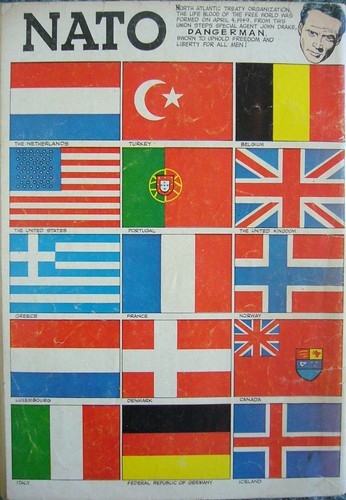
Biographies? Did Patrick McGoohan need to read them in these cases? Not really, he knew and associated with these people, who were caught up in exactly the sort of subtle attacks on individual thinking that The Prisoner railed against in its meanderingly allegorical way. Patrick McGoohan once said that the Prisoner was associated with something that had been in his own head, all his life. As I've said before in these Blogs, to guess what might be in a man's head, it always pays to take the time and trouble to find out what has gone into that head as it lived a life - a life that segued from the real life of intranational Cold war politics as they affected actors in the free West to the fictional life of a secret agent battling the forces of oppression in the East - on behalf of the Internationalist NATO.

Was Patrick McGoohan personally interested in Politics - with a capital P - ? His 1990 interview suggests not, "People who jump on those bandwagons have got to have a bandwagon to jump on to, so they'll do it anyway. If its not Ban the Bomb, it'll be something else." As an actor at that time however, he would have naturally been a keen observer of people and the under-currents of those people and what made them who they were, and as he remarked later in that 1991 interview:

I like reading biographies of the big guys from way back..............

Monday, 21 December 2009

McGoohan on other people's Minds . DISinformation - How fallacious Fan-fables control the present by controlling the past.

As I have explained in some of my earlier blogging, the initial Prisoner cult clubs began around 1978, but around ten years later began to percolate their Information into the mainstream. This began with the first book outside of the cult itself in 1988, The Official Prisoner Companion. Presumably the word "Official" was used to define this publication from the club itself, which is ironic as the book largely perpetuates the many misconceptions and outright errors of the so-called research carried out by that club as well as beginning to invent it's very own fables, as I discussed in my first two or three Blogs.

Regular magazines were evidently published to the Prisoner Club subscribers in the 1980's, disseminating information to all of them. Much of the information seems to have relied solely upon various interviews with cast and crew members of The Prisoner, who were eagerly invited to various Conventions. These witness statements were made decades after the events, and were sometimes woolly and often a statement from one individual seemed to contradict the statement made by another individual. An outstanding example of this is the Prisoner writer, Lewis Greifer, who is reported by the cult members as saying in interview to them, that he and his friend, the ultimate script editor, George Markstein were discussing the concept of the prisoner before the involvement of Patrick McGoohan! On the other hand, the opinion of Bernie Williams, a young assistant director then, (and since a major Hollywood producer) was given unequivocally and is publicly available on an A&E video interview. He is quite clear that McGoohan was constantly under pressure from every member of the crew for direction and purpose from the very commencement of filming in Portmeirion.

Such contradictions are rarely resolved factually. Influential club members simply seem to elect to believe one version of events over another version and as the most up-to-date book published to accompany the Network's 2008 dvd set, reveals, these incorrect versions of history pervade even the most honest attempts at analysis to this day.


This often impeccable book refers to these contradictions but then, without any overriding definitive reason simply states that it was "in fact Markstein" who initiated the entire concept [page 11] . On the previous page however there is damning evidence of how much this book relied upon fallacious fan-club material for this opinion.

The production Guide states that Markstein worked as a crime reporter in Liverpool. I have seen no evidence that this is true. I have documented evidence that Markstein never left London and was in fact employed at the 3rd US Airforce base in South Ruislip as one of the writers for their Airforce Base newspaper, the UK Eagle. Markstein is also referred to as working for the Stars & Stripes military newspaper. He never wrote for that 'paper. As late as 1963, he was still suborning himself from the UK Eagle house magazine, as a correspondent for 'The Overseas Weekly', known to the American GI's of the time as 'The Oversexed Weekly', in light of its constant 'racy' content.

Because the cult stories and versions of history were never based on verifiable facts or even documented evidence the errors about George Markstein have significantly influenced the muddle about the series' production history. Many accounts even suggest that this man (who was born in 1929 making him 15 in 1945) had been involved with WW2 espionage! Unquestioning acceptance of this sort of legend have added unwarranted credence to the influence he had upon the TV series. As mentioned, the page of The Overseas Weekly I have scanned is from 1963. George Markstein did not even have a job in television three years prior to the inception of The Prisoner. It is worth remembering that he did not originate a single episode of The Prisoner, whilst McGoohan wrote at least three single-handed. Markstein finally wrote his first novel, but not until 1974, seven years after The Prisoner. His creative credentials simply do not justify the claims made on his behalf by the cult of The Prisoner..

In 1996, an American broadcaster commisioned Scott Apel to commentate upon the series for Channel KTEH in America as they broadcast the series in an episode order that had been concocted by them to try and *make sense* of The Prisoner. These commentaries naturally influenced those watching the programme and some of the ideas are as interesting as any others in regards to the themes underlying elements of the show. However, the information about the history of the production reveal a fascinating mixture of the insidious influence of the cult myths whilst simultaneously making completely contradictory statements about the same history. Some examples will make this clearer.


An Official book from 1988 stated that Living in Harmony was somehow censored by CBS in 1968 (see earlier Blog), yet an American expert evidently knew that this story was nonsense, but rather than challenge it, he instead puts a whole new twist on the legend and states that the series only had a sixteen week slot and so one episode had to be dropped. The expert knew the cult-myth was was incorrect but rather than find out the real reason for the episode that I have explained in the blog referenced, the self-styled expert merely invented a whole new *fact* !! As can be seen from this contemporary press cutting, there is no doubt whatsoever that the series was initially expected to run for the full 17 episodes.


It is especially annoying that the KTEH channel should commision an apparent expert and then present what was at best, a wild guess, as historical fact. Apel presents various ideas about what he calls the Symbology of the series and that is fair enough - you can agree or disagree, which is quite the purpose McGoohan desired of his show, but for Apel to present physical, real-life history in such a slap-dash manner is quite reprehensible. He was of course following the lead of the cult clubs.

The story of Living in Harmony and its absence from the schedules is a simple one, but the truth is so hard to find primarily because of a complete lack of any research scholarship in the past. There is a very strange passge in the 2008 Network book, which reads: Following The Chimes of Big Ben there was a one-week pre-empt before the series continued in standard UK order for a further eight episodes [page 66 ironically] I have no idea what this is even supposed to mean; but it is yet another unresearched version of the story I have fully explained here: http://numbersixwasinnocent.blogspot.com/2009/06/who-controls-past-controls-future-who.html

The story of the Harmony episode is a cautionary one, but apart from the stupidity of it all, with different factions of the interest group believing different versions of real-life history, as if it was equivalent to their differing opinion of what the show itself *meant*, it creates no real problem. However, the Creation Myth of the cults is more troubling. Scott Apel and KTEH amplified the still-echoing fallacies in 1996, as this video shows:


Apel perpetuates and amplifies the myth that George Markstein was the creative force behind The Prisoner and compounds the injury by then apparently congratulating McGoohan on the things he contributed.!!. The symbology of this is what we British would call Adding Insult to Injury.

It is of interest to note that in 2005 and in 2008, the only document claimed as extant that Markstein had anything to do with creating the prisoner was a *four-page* document. I have even seen a qualification of this story that the original of this was most certainly typed on Markstein's typewriter; implying that whilst no actual creative origination by Markstein can be corroborated, the use of his typewriter is proven !! Anyone interested in The Prisoner must surely take careful note that George Markstein was employed by Patrick McGoohan's Everyman company as a Script Editor. It would therefore be his job to type up such documents. There appears to be no evidence to demonstrate that Markstein did in fact originate this material in a creative sense. Interestingly, in the 2008 Network volume, two of the original writers' statements are referenced:

Page 117: Anthony Skene [writer of Dance of the Dead]: "I saw not one piece of paper" recalled Anthony Skene..... concerning the lack of a writers guide from Markstein during his meeting at MGM... "the show was a cosmic void. They sat there waiting for ideas...... a free hand? Oh God, yes!"

Page 129: Vincent Tilsley [writer of Chimes of Big Ben]: Vincent Tilsley received a call from George Markstein......... This was at a time when there was no format document and all that Markstein could offer the prospective contributor was a script for Arrival.

These two statements not only corroborate each other, which is a rare instance in the cult of the prisoner, but also give the entire lie to the idea that the script editor was even doing his job properly, never mind originating any of the ideas for the show. They also appear to contradict what has been published in even the more reliable prisoner history books: Dave Rogers, 1989: "What is beyond doubt, is that well before production got under way Markstein produced a four page writers brief."

Where Scott Apel got his idea that a sixty page outline existed can only be traced back to comments by Patrick McGoohan, who mentions a detailed brief he placed before Lew Grade. He mentioned this document to Warner Troyer in 1977:

I wrote a 40-page, sort of, history of the Village, the sort of telephones they used, the sewerage system, what they ate, the transport, the boundaries, a description of the Village, every aspect of it; and they were all given copies of this and then, naturally, we talked to them about it, sent them away and hoped they would come up with an idea that was feasible.

Presumably McGoohan would have passed this document to his script editor, as any Producer would. What then happened to it ? Nobody seems to know. Truly the web of disinformation about the production history of The Prisoner is worthy of the very best the village could ever have thrown at the hapless, but never helpless Number Six.

Merry Xmas from Moor and I look forward to seeing you in 2010.

Tuesday, 8 September 2009

McGoohan on my Mind: The time has come, the Larkin said, To talk of many things: Of shoes and ships and sealing-wax. Of villages and things.

Colony Three was one of the first of the revived Danger Man shows. One of the last to be made was called The Paper Chase. Of especial significance perhaps is the fact that this episode was actually directed by Patrick McGoohan.


It has something of a 3-Act feel about it. The ‘third act’ takes place in a ‘safe house’. Everyone is a guest, but all are in hiding. The episode has a number of intriguing elements. A woman named Nandina runs the safe house. Played by Joan Greenwood, she could easily be seen as a putative Number Two in the village. She watches her ‘guests’ on a primitive CCTV system.


Spotting Drake infiltrating another ‘guest’s room on her monitor she is worried that Drake’s actions threaten to spoil her carefully constructed security

and so she knocks him out

and when he wakes, he has been taken to a new place, whilst unconscious. As he wakes, there is what could almost be an early try-out for the iconic prisoner opening speeches.


Where am I?
In the Via del Sella da Nici.. A small hotel – Giorgio, the proprietor is a friend of mine.
Where are my things?
Your suitcase is over there. …[some episode detail]…… You are very agile and extremely devious
My apologies
You have money?
Hummm
If you’d like to stay here a day or two, it’ll be alright
What’s the catch?
None – What’s your name?
You have it
Your real name….
Harry…… verderci

Prior to this, when Nandina and Drake had fallen out over his behaviour. She castigated him:

I know everything that goes on in this house. It’s useless for you to sit there with your enigmatic face.
Are you the judge and jury then?
If you like…… and you have only one plea
Guilty?
Guilty!

So, separated by the two years of 1964 and 1965, two episodes of Danger Man, Colony Three and The Paper Chase evidently prefigure both plot elements and stylisations that Patrick McGoohan carried forward into his 1966/67 project. Like a giant standing on his own shoulders, he could see that little bit further than before.

It is a minor piece of amusing trivia to note that the conclusion of The Paper Chase has Drake escaping aboard a go-kart.... A Lotus 0.07 perhaps..... I have read one story from the prisoner cult archives that the Lotus 7 was personally chosen by McGoohan on a visit to the Lotus factory-works, ditching the previously scripted notion of Number Six driving a more glamorous Lotus Elise coupe. In the press of 1965 he is pictured fooling around on a go-cart.


It's not evidence of all that much, but it is interesting to imagine possibilities.

There are many small asides in many different episodes of Danger Man that reflect ideas or *gimmicks* within The Prisoner. Within the prisoner cult there has been a long and slightly foolish debate about whether or not Number Six was or wasn't John Drake. I debunked the silliest parts of their notions in one of my first Blogs. However, whilst they delved into their own *back-story* fantasies about what were completely fictitious characters anyhow, they completely missed the point that of course Patrick McGoohan's ideas were hugely influenced by his experiences of the scripts and themes that the Danger Man series had explored over several years. McGoohan was no passive performer in Danger Man however and he shared in the formulation of those ideas and themes, as well as their eventual exposition in the many episodes of Ralph Smart's creation. His lack of passivity is often remarked upon and indeed his increasing frustration at the limits laid upon his creativity probably led him to approaching Lew Grade with his proposal for his own original series. Sidney Cole possibly deserves a little credit in fact for The Prisoner project ever happening. In one interview the distinguished producer recalled his having something of a dispute with the star of his show. He recalled that when Patrick McGoohan complained to him (Sidney Cole) about why it was that he (Sidney Cole) always had the final word; Sidney Cole explained to his recalcitrant star that the reason he (Sidney Cole) had the final say was because he (Sidney Cole) was the producer. That was WHY.....

Patrick McGoohan evidently took the lesson to heart when he made himself Executive Producer of The Prisoner. This time he (Patrick McGoohan) would have the final say. He would be Number One.

Harry Verderci ..... I'll be Back.

Monday, 7 September 2009

McGoohan on my mind: Where Am I? In the Village.........

In my earlier Blogs I have touched on the cult fan fixation on the influences underlying The Prisoner – such influences as Kafka, Hesse, Panopticons and Carl Jung. In a similar way the fans have puzzled over the underlying influence of where the idea of ‘The Village’ came from. Ideas have varied from the mundane,
viz. the British Butlins Holiday Camp
http://www.butlinsmemories.com/bognor/maps/1967.htm
to the arcane - viz. isolated Scottish cottages
http://secretscotland.wordpress.com/2008/09/05/inverlair-lodge-for-sale
It is actually a fairly obvious fact that The Village, like much else that influenced McGoohan, simply would have come from his own working life. Why the prisoner fans sought other *solutions* is I suppose partly due to their ignorance of the 1960's 'Danger Man' series at the time of the cult inception in 1977, and partly due to their subsequent determination to largely ignore the career of the series' creator in favour of pursuing their own agendas.

In 1964 Patrick McGoohan took on the mantle of the secret agent John Drake, once again. One of the earliest episodes remarkably links the origins of not only Danger Man, but also The Prisoner as well, in the most complete and elegant way. Colony Three was one of the first episodes of the new hour-long series of Danger Man. The briefest watching of this episode will make apparent the connections between it and the concept of a ‘Village for Spies’. McGoohan may have half-forgotten the influences himself, so much part of his own psyche must they have been by 1966; just as all the other films and plays I have mentioned, in my earlier Blogs. These experiences and his own contributions to them were inevitably part of what made him who he was, professionally, and what ideas he must have had. Indeed a correspondent once reflected to me that once a person knew the details of Patrick McGoohan’s career prior to 1966, the origins of The Prisoner became almost too obvious.. :-)).

The plot of Colony Three revolves around M9 (Drake's department) noting that many Britons have gone missing (apparently to the Eastern Bloc) and none of them have ever been heard of again. Drake is tasked to impersonate a man who has been detected as about to defect. After some adventures Drake arrives in deepest ‘Russia’, but in a strangely familiar-looking location – Hamden New Town.
I won’t dwell too long on the plot. It is familiar to many anyhow, but here are a number of lines of dialogue from the early scenes, after Drake’s arrival……..

What is this place?
Mr. Donovan will explain everything

Geography is a matter of physical illusion. Lines on a map. Words on a signpost.It’s this that gives a place it’s identity. After all, you are where you recognise yourself to be. Mr. Donovan says that all countries are countries of the mind.

Well – the layout of the village is quite simple. As you can see – we’re still building.

This village is one of our best-kept secrets

You think there are no spy-schools in England?
Of course there are.

In this village we transform our guests into Englishmen

You’re quite free to wander round the village. Just don’t go outside it.

You realise that none of the residents can leave the village – ever.

The mysteriously other-worldly place is supposed to be a home-from-home. Drake shares a room with another *defector*, but Drakes room-mate begins to revolt against the situation. It is not what he had been led to believe he was defecting for. He argues with Drake, who is pretending to co-operate whilst in fact taking photographs that will reveal the village to his superiors. The room-mate quarrels with Drake:
You wanna keep your nose clean don’t you. Look after Number One and to hell with everyone else!

Drake even suffers an *Interrogation*, proving that in Danger Man at least, "Heroes do sweat"..... You'll need to click on the photo to make it big enough to see the sweat of the hero... :-)

In another scene a young woman who has also been deceived into joining the village has a conversation about her unhappiness:

Have you settled in?
I don’t want to settle in!
Oh come now, we must all make the best of our circumstances

Later on Drake has a conversation about this tragic young woman, who unlike him, can have no hope of escape:

You’d have thought she would have realised by now
Ummm… What?
That once people enter Colony Three… they cease to exist…..


In The Prisoner series, much of the basic concept of the village comes from the ideas in this episode – especially the notion of calling the place a village, rather than a town, or a settlement, or even a colony ! The purpose of the village is of course inverted to become a prison for spies rather than a school for spies.

There is a film, made in 1960, that prefigures both Danger Man and this village. Man on a String is a moderately obscure American-made ‘exposing-Communist-Conspiracy’ Fifties-style B-movie. It contains much of the gadgetry that would inspire elements of the TV shows like Danger Man, and also the techniques of mixing stock location footage with studio-work. There were many cinema movies of this nature of course, but what makes this one stand out in the context of this particular Blog is that it involves a Colony Three style school for spies. Boris Morros’ book about his real-life espionage adventues inspired this movie.

Many elements of the movie have commonality with Ralph Smart’s Danger Man – part of the same zeitgeist. Did the screenwriter of Colony Three see this movie once? I have no idea, but the movie contains the key plot element of a top secret Soviet spy school where young Communists are converted into ‘typical’ young Americans, just as in Colony Three, young East Europeans are trained to become typical English men and women, and just as in Colony Three, the secret agent returns so that all these trained agents can be identified and apprehended later.

If you click on this picture you will see that The Prisoner may well have some arcane influence of Kafka, but possibly not the one everyone thinks of!! The final picture is of Ernest Borgnine, who plays the double-agent, speaking to the students of the Spy School, just outside Moscow. It would be nice to think that both Ernest and Patrick noted this collison of their career paths, when they met on the set of Ice Station Zebra in 1967, but I don't suppose either of them would have been aware of these cross-currents.

The Boris Morros story was a significant story in itself but merely one of many such espionage events in the 1950's and 1960's. Here are just two of them, the second would attract Patrick McGoohan's attention much later in his acting career: http://www.time.com/time/magazine/article/0,9171,824789,00.html http://www.time.com/time/magazine/article/0,9171,872180,00.html

The interlocking jigsaw of these films and TV shows reflects the statement Patrick McGoohan once made when he was complimented upon the brilliance of The Prisoner, “Just a grain of sand in the desert” he modestly demurred. He may not have consciously realised himself where his ideas had exactly come from, but there is clear evidence from his career that these ideas were all derived from the work he had been immersed in, for several years. His own personality doubtless then drew in the allegory, shading as they do all the plot-lines of his Prisoner entertainment.

It is always dangerous to draw too many conclusions from too little *evidence* but during Drake's mission to Colony Three he is assigned to the Citizens Advice Bureau in the village, where there are various instructional leaflets dotted about the walls. Perhaps my snapshot doesn't do them full justice:

But hopefully you will forgive me.

Whilst the origins of the notion of a village for spies must have some connections to McGoohan's memory of this episode, it should be borne in mind that Colony Three was one of the earliest mid-Sixties episodes, dating back to 1964. One of the final episodes of Danger Man/Secret Agent also carries very obvious nuances and influences that infiltrated The Prisoner, and demonstrate how McGoohan was able to shift so effortlessly from the first show into the next. He himself said that The Prisoner began out of boredom, but that comment should not be construed as meaning he had been idle. He was remarked as working 18hours a day on Danger Man. He would naturally hit the ground running, with renewed vigour - when Lew Grade agreed to support Patrick McGoohan's very own creation - in colour !

Moor of the next thing in my next Blog. I just have a little paper to chase first.

Be Blogging you

Sunday, 14 June 2009

McGoohan on my mind: Religion Sex & Politics

It won't take anyone long to find references to Patrick McGoohan and religion. (omg! I have just increased the number myself!) After all, a man who said that up to the age of 15 he planned to become a Catholic priest, who made his London theatre debut playing a vicar (Serious Charge) and had his 1959 West End Sensation playing a Pastor (Brand) was always likely to be thought of as having religious persuasions. Then, when playing his TV hero 'John Drake' he was quoted as saying that "Every hero since Jesus Christ has been moral". Having lined himself up for religion he then conflated matters by bringing up sex, a subject inextricably wrapped into any Christian philosophy. His rejection of the part of James Bond in 1961 would further make his moral stance most easily explained by his pre-supposed religious principles. In the 1960's these attitudes were seen as relatively normal and cetainly to be approved of by Joe Everyman. By the late 1970's the sexual and social revolution in Britain made these old comments seem quite unusual, at least in the world of Showbiz and fan culture.

When prisoner fans began to try to unravel the show's 'secrets' they always sought to attribute what they found in the show into the character of their auteur. This crops up in the very first public outing, in Canada, in 1977 in those TV interviews I highlighted in my earlier blogs. Here is one part of the transcription:

I understand, in reading a little about you, that you're a very religious man, and my question pertains to "Fall Out." I have interpreted a lot of the acts as being...having this content. I'm thinking specifically of the crucifixion of the two rebels, of when their arms are drawn apart, the temptation of No. 6 by the President of the Village, of the temptation of Christ...
McGoohan: They give him the throne.
"Drybones," all of that. First of all, would you agree with my idea that that is intentional? That it is...
McGoohan: No, I had never any religious inspiration for that whatsoever. I was just trying to make it dramatically feasible. Certainly the temptation with the guy putting me up on the throne and all this stuff, ah...it's Lucifer time. But I never thought that, at that moment. Maybe somewhere in the back of my mind it was there..... "And the hip bone's connected to the thigh bone" thing....... I just thought it was a very good song for the situation and also was applicable to the young man because, as you know, it's easy for us to go astray in youth and he was astray and he's trying to get everything together again.


He couldn't have made himself clearer and yet many years later (2005) a prisoner fan writes of what seem to be still-maintained ideas:
it was also central to McGoohan's life. As "The Prisoner" progressed it became more and more a reflection of McGoohan's will and McGoohan's angst and less and less the adventure series intended by Markstein. McGoohan's own personal agenda spilled into "The Prisoner" both in script and on screen. His view of women, politics, education, personal freedom, the cold war, youth rebellion increasingly came to the fore and, at the very end, out in front of the cameras, came that which he held most dear yet perhaps questioned most - his faith.


Apart from Fall-Out, the other episode that seems to loom large in religious vision is Chimes of Big Ben, when Number Six's art-work engenders christian visions.


Watching the programme myself I have to say that Number Six's cynicism about the merits of modern art seemed far more on somebody's mind than religious iconography. I have noticed a few opinions that showed an intriguing flexibility. The vague references to churches in the above scene were long held to demonstrate McGoohan's beliefs. Later, when script research showed that religious references were deleted, this was also taken to demonstrate his beliefs, on the premise that, as a *believer* himself he wanted religion to not be involved in the programme. As any good Number Two would have said, "Heads, fans win. Tails, McGoohan loses". It is obviously my intention to polemicise. But why do fans of this series so maintain their fictions about Patrick McGoohan I wonder. Anyhow, this next McGoohan interview outtake was published in 1995, a whole decade before, in an interview at the time of *Braveheart*, McGoohan was talking about about his 1974 project on the movie 'Catch My Soul'. He was referring to the later editing of the film by the Producer :

I lived in New Mexico at that time and the producer did too. He'd heard I was available and that's how, after the hiatus that followed The Prisoner, I came back to the profession. Unhappily, in the process of making the film, he got religion. Catholicism. He became a convert; he took the film and re-cut it. The editor warned me, I asked that my name be taken off it, and, unhappily, that was not done. The result is a disaster. What's more, he added 18 minutes of religious stuff. Ridiculous.

How could any fan still contend in 2005 that McGoohan had some strong loyalty to any organised religion, even his own boyhood one, after reading that comment made in 1995 about his feelings of an event as long ago as 1974 ? In case you think my polemicising is leading me to labour some randomly obscure comments I found on the internet, you will find that the most recent *Official* prisoner books on retail sale include pontification about McGoohan's (fan-supposed) religious beliefs and their consequent influences on the series as produced.... the same books of course that now say The Prisoner was a commercial failure in 1967/68, which statement I have pointed out in an earlier Blog, is a nonsensical statement.

As an aside - what does *Official* mean I wonder? It certainly seems to have nothing to do with Patrick McGoohan. *As authorised by the current holders of the film copyright* presumably, which copyright has been bought and sold more than once and whose approval is fairly meaningless. You will also find reference to McGoohan's 'strong religious beliefs' in the unauthorised (by anyone) 2008 bibliography, ludicrously entitled 'Danger Man or Prisoner'. I use the word ludicrous because it's main attraction, of cataloguing the length, breadth and diversity of McGoohan's acting career, only emphasises the paucity of reducing him to a caricature of some Jungian *cult memory* in the title, and to be honest, the bulk of the book's pages.

Mr. McGoohan of course put it best himself when referring to his cult fans in an interview with a senior member of the fan appreciation society - and yet an interview which is never quoted by those same fans and seems almost wilfully unknown to most:

It's a step into cultism. In the end it's got nothing to do with the subject - it's become a sort of entity in itself. There's a word that I can't find at the moment... it may come to me.

McGoohan made that comment in 1991. The interview was long and wide-ranging and he discussed the prisoner show in considerable depth. It vanished into a small circulation enthusiasts magazine, rather than the *official* or *authorised* fan archives, for endless republishing. Needless to say, quotes from this interview have never been featured on the regular reissues of The Prisoner dvd's, especially as within it, McGoohan complains about the so-called *missing* episodes: the Alternate Episodes, as the marketing men call them.

But... lets get back to religion...... or maybe I'm done with religion....

Moor sex perhaps? Next time. bCnU.