Showing posts with label Fan Myth. Show all posts

Tuesday, 9 February 2010

McGoohan and other Peoples Minds - UnMutual Americans and The Prisoners Who Were Free

In 1991 a magazine called The Box interviewed Patrick McGoohan extensively about The Prisoner and his creation and management of that show. Almost no fan site or book seems to refer to this interview. The byline to my Blog is taken from that interview. The interviewer was admirably meticulous in his transcription. One exchange may give some clue why this generous and fulsome interview with the creator of the show has almost been completely ignored and forgotten.

You are quite happy to have people appreciating The Prisoner?
Oh, of course. yes. And I think that they've done, and that they still do, some terrific things. they are a very talented group of people. I don't know if you've seen any of their publications that they put out, but it's professional stuff.
You do see it then?
Well, they send it to me.
You do look at it?
Sure!
Do you get a buzz out of reading about the programme?
Not really, no.

It's a great interview, but because of his refusal to court popularity McGoohan's words have been read by seemingly very few. The line of the fan clubs seems to have always been that their Number Six is a taciturn hero and therefore McGoohan had to be so portrayed too. Anyhow, my Blog this time isn't really meant to go on too much about this, but rather to complement my previous Blog. In that Blog I referred to contemporary echoes of The Prisoner since the programme was made. In this Blog I would refer the reader to the echoes from the even earlier past, that perhaps informed McGoohan, as he created The Prisoner with his collaborators. However, before I move onto those echoes specifically, I'd just like to reference a couple more exchanges from The Box interview.

Is there anything in literature, perhaps..... that influenced you?
No, not really.
..... in the work of carl Jung, for instance, or John Fowles......
Well, they may be there, but I wouldn't know....
And there's Franz Kafka....
Well again, I wouldn't know.....

Did you read any Herman Hesse?
No, I don't read that much really, of that sort of stuff. I read biographies......

The Glass Bead Game
Ah, The Glass Bead game... I've heard of it but I haven't read it.
You ought to read it - it's full of The Prisoner
Is it? well, I'll be darned..............

Jung? I haven't read a word, not one word.

I don't want you to get the impression I am mocking this interview; it's criminally ignored by the prisoner classes, but there we are, people read what they want to read I guess, or what they get the chance to read. The purpose of this Blog is the clue Patrick McGoohan gave to something he would possibly have waxed far more eloquently about.... Biographies.... Himself for instance. If the Prisoner fan took more interest in him, the Prisoner fan might find he had something far more intriguing to reflect back at them.

My last Blog utilised the recent work of Adam Curtis to reflect how The Prisoner had resonated in real life over the forty years since it's realisation. The thirty years before The Prisoner had been resonating their own real life and Patrick McGoohan had been there to soak it up. The McCarthy campaign, and the HUAC hearings that had preceeded them by a few years, are often referenced as a resonance in the mind games of the show. Here are a few characters who knew more than most about the perils of being unmutual in the global village of the 1950's.

The men are from left to right (the annotations are from wikipedia unless otherwise web-referenced)

Alexander Knox
In 1944, he was chosen by Darryl F. Zanuck to star in Wilson, the biographical film about Woodrow Wilson, for which he was nominated for the Academy Award for Best Actor. However, during the McCarthy Era, he was blacklisted by the Hollywood movie studio bosses and he returned to England. In 1952 Patrick McGoohan spent two weeks in a theatre tour with Knox and of course was a support to Knox's star in High Tide at Noon.

Joseph Losey
During the McCarthy Era, Losey was investigated for his supposed ties with the Communist Party and was blacklisted by the Hollywood movie studio bosses. His career in shambles, he moved to London, where he continued working as a director. Even in the UK, he experienced problems: his first British film, The Sleeping Tiger, a 1954 film noir crime thriller, bore the pseudonym Victor Hanbury, rather than his own name, in the credits as director. Joseph Losey was the director of McGoohans third Rank film, in 1958.

Cy Endfield
In 1951 Endfield was named as a Communist at a HUAC hearing. Blacklisted by the movie studio bosses, he was unable to get work in Hollywood and moved to Britain where he wrote and directed films under various pseudonyms, often starring fellow blacklistees. In 1958, Endfield was nominated for a BAFTA Award for Best British Screenplay for Hell Drivers. Enough said, probably.

Sam Wanamaker
In 1951, Wanamaker made a speech welcoming the return of two of the Hollywood Ten. In 1952 at the height of the McCarthy "Red Scare" period, despite his distinguished service in the U.S. Army during World War II, Wanamaker learned that he had become blacklisted by the House Un-American Activities Committee (HUAAC), which he discovered while filming Mr. Denning Drives North in the UK. Wanamaker consequently decided not to return to the United States. Instead, he re-established his career in England, as actor on stage and screen, director and producer. Sam Wanamaker was the theatre director of one of of Joan McGoohan's main West End stage roles and of course later worked with Patrick McGoohan himself on Danger Man.

Albert Dekker
Left-leaning box-office stars such as Edward G Robinson, James Cagney and Gregory Peck benefited from studio protection, while character players such as Anne Revere and Albert Dekker, among many others, had to take long holidays. In Hollywood as everywhere else, rank has its privileges. http://www.productmagazine.co.uk/index.php/film/P1/
Patrick McGoohan worked with Albert Dekker in one of his formative TV roles from 1955, All My Sons.

The woman in the group is Betsy Blair
After work in the theatre, Blair began her film career playing supporting roles in films such as A Double Life (1947) and Another Part of the Forest (1948). Her interest in Marxism led to an investigation by the House Un-American Activities Committee and Blair was blacklisted for some time, but resumed her career with a critically acclaimed performance in Marty (1955), winning a BAFTA Award and a nomination for an Academy Award for Best Supporting Actress. Betsy Blair played the wife of Patrick McGoohan's character in his 1962 movie, All Night Long.

Biographies? Did Patrick McGoohan need to read them in these cases? Not really, he knew and associated with these people, who were caught up in exactly the sort of subtle attacks on individual thinking that The Prisoner railed against in its meanderingly allegorical way. Patrick McGoohan once said that the Prisoner was associated with something that had been in his own head, all his life. As I've said before in these Blogs, to guess what might be in a man's head, it always pays to take the time and trouble to find out what has gone into that head as it lived a life - a life that segued from the real life of intranational Cold war politics as they affected actors in the free West to the fictional life of a secret agent battling the forces of oppression in the East - on behalf of the Internationalist NATO.
Was Patrick McGoohan personally interested in Politics - with a capital P - ? His 1990 interview suggests not, "People who jump on those bandwagons have got to have a bandwagon to jump on to, so they'll do it anyway. If its not Ban the Bomb, it'll be something else." As an actor at that time however, he would have naturally been a keen observer of people and the under-currents of those people and what made them who they were, and as he remarked later in that 1991 interview:

I like reading biographies of the big guys from way back..............

Sunday, 17 January 2010

McGoohan on my Mind: Harmonising the Disharmonious - The Filler Episode that took longest to make and cost more than any other -Conundrum.

My very first Blog was on the subject of that arch *Filler Episode*, The Girl Who Was Death. Alternately vilified or dismissed by many observers as cheap none sense or amusing kitsch, I explained my viewpoint of how this (in effect) penultimate episode was used by McGoohan to strip away the fourth wall of reality, in a theatrical sense and launch his viewers into the final two-part epsiode, that ran the gamut of the purest stage-surreal theatre to the glitziest filmed special-effects trickery of the television medium.

For my 21st Blog, I would like to try to make amends for not stopping at 17 by focussing on the arguably archest of Filler episodes, Living in Harmony. This is of course the infamous Cowboy episode, whose original title of Do Not Forsake Me, Oh My Darling, was transferred to an episode carrying the pedestrian title up to that point of Face Unknown. Thus the title-song of one of the greatest Individualistic Westerns of the 1950's, High Noon, found itself primarily referring to the lost and previously forgotten fiancee of the hero, Number Six, whilst the Western resume of the adventures of our hero so far, was named after the town in which he now found himself, Harmony. Living in Harmony was shown as Episode 14, immediately before The Girl Who Was Death and one of its small aside roles could have been to introduce the notion that children were present in the village.


Curiously enough, one of the criticisms I've read of the episode The Girl Who Was Death is that it uses children as a plot device and yet children had never been seen in the Village up to that point - yet another Fan Myth, as you can see. Did McGoohan introduce them in Living in Harmony for precisely the purpose of utilising the device of children in the very next episode? Who knows? You decide for yourself, but bear in mind that children were specifically requested for Living in Harmony, according to Frank Maher, who provided his own as two of them.

The genesis of Living in Harmony has been chronicled in some aspects by the evident initiator of the concept and to some degree, the actual script-writer: Ian Rakoff. Writing in his effective autobiography, Rakoff describes his arrival in the world of The Prisoner sometime around the latter weeks of 1966 or early weeks of 1967, depending on how you read his memoir, which is infuriatingly date-unspecific. His script passed through the filter of David Tomblin to Patrick McGoohan, who, Rakoff tells us, had personally comissioned the story and seemed to have taken a great interest and enthusiasm in it, not withstanding his later comments in interviews congratulating interviewers on their perspicacity of noting the episode's *filler* nature. Ian Rakoff's background story, and a current interview (at 2010) is included here:
http://electricsheepmagazine.wordpress.com/2009/12/30/electric-sheep-podcast-living-in-harmony-with-ian-rakoff/
His story is an interesting and informative one but of course, as he admits himself, he had relatively little contact with McGoohan and just like most other of those closely associated with the Prisoner Project, seems not to have been privy to the close-knit producing/directing team of McGoohan and Tomblin. Reflecting on the mirrored images he presents might benefit from considering what Living in Harmony was actually seeking to add to the 17 episode run of The Prisoner.

In the course of his descriptions of his version of Living in Harmony, Ian Rakoff does not really explain to the reader what it was about the final form of the episode that he found so alien, or as he writes in his memoir, "Watching the episode was like having my insides torn out. For a moment I couldn't believe I'd written any of what i was seeing. It seemed familiar but from somewhere far away and long ago. Dialogues struck chords." Could it be that the big difference that he discerned was that the Cowboy episode was no longer an episode? Like The Girl Who was Death. Living in Harmony was no longer seeking to progress the story of The Prisoner. Instead it served as a resume of the entire concept of the series itself, to date; but by translating The Prisoner into a cowboy fable McGoohan was making the viewer find the universal nature of the story he had been crafting. The Cowboy Western was an apocraphylic format. High Noon, from 1952 was vilified by some elements of the Hollywood. It has been cited as an allegory itself "This film was intended as an allegory in Hollywood for the failure of Hollywood people to stand up to the House Un-American Activities Committee during the Sen. Joseph McCarthy Red-baiting era." http://www.imdb.com/title/tt0044706/trivia

However, it should also be remembered that High Noon received four Oscars, so Hollywood certainly gave the movie its full blessing, with John Wayne collecting the award on behalf of Gary Cooper. Another movie from the same era also has echoes of Living in Harmony: "In the old West, a small frontier town is being controlled by ruthless mob boss Decker (Lyle Bettger) and his cronies. After the local sheriff dies under mysterious circumstances, Decker arranges to have the town drunk (Thomas Mitchell) appointed sheriff, thinking he will be ineffectual. But the new sheriff sends for Tom Destry, son of a famous two-fisted lawman, to be his deputy. When Tom (Audie Murphy) arrives, he isn't exactly the swaggering he-man the sheriff had in mind. In fact, Destry doesn't even carry a gun. But the new deputy's mild exterior masks a fierce determination to see justice done, as Decker and the other locals soon discover." http://www.imdb.com/title/tt0046906/plotsummary

Interestingly, the first movie incarnation of Destry was in a 1930's movie starring James Stewart who McGoohan is known to have personally admired.

Whatever its antecedents and whatever Ian Rakoff's original script's unique elements may have been, what Living in Harmony did was to tell the story of The Prisoner all over again, but this time in a Western town. This is almost certainly not what Rakoff might have intended, especially as he seemed to be under the impression that his script was to be just one of several more, leading into a further season of shows.

It is a remarkable fact that High Noon is said to have taken four weeks to shoot, whereas Living in Harmony is believed to have taken five weeks, at least so it is reported in the 2009 book that accompanied the network dvd releases. Many of my earler blogs have challenged some of the long-repeated but frequently incorrect, misleading or downright deceitful myths about the production history of the remarkable series that is McGoohan's Prisoner. Some consideration of the circumstances surrounding the making of Living in Harmony are worthy of logical analysis. Much of the production history has been concoted by interviewing cast and crew over the several decades since 1967. Many of the testimonies are completely contradictory and Living in Harmony is a real case in point. It is regarded as a filler episode and yet it appears to have had the longest shoot of any episode. It is termed a filler episode and yet it appears to have been the most expensive single episode produced, the spent budget estimated at around £75,000.

The long-held view of The Prisoner production by its self-appointed experts has been that as Spring 1967 ended, with 13 episodes pretty much *in the can*, a second season of 13 were planned. This claim is made despite the unambiguous denial of the owner of the Production company, Patrick McGoohan. One version of the myth that attempts to contradict McGoohan is that the cast and crew were asked to introduce ideas - this is indeed how Ian Rakoff came to submit his original ideas for Living in Harmony - However, so far as is recorded there were at least four other unused ideas or script outlines that were never used, despite the fact that yet another idea was concoted between McGoohan and Tomblin, to make what became The Girl Who was Death. Despite still not having written his final script, McGoohan happily spent five weeks shooting one episode, when the cult historians would have you believe he was desperately seeking to scrape together as many as six more episodes. He was also happily spending nearly 30% more on this one episode than he had spent on any other, and these same historians will have you believe his budgets were being breached and Lew Grade's accountants were on the warpath. Clearly the real history Patrick McGoohan was living was a very different history to the one now frequently shoe-horned against these plain facts.

Most of the history writers will then attempt to explain this bizarre contradiction of the circumstance of real life against their concocted history-making by implying McGoohan was wilting under all the pressure and losing control of the whole project. What could be further from the truth? Consider that the Producer, Star, erstwhile Director and Script-writer was simultaneously making a Hollywood movie, and juggling his TV project, and when he had finally completed 16 episodes, was still able to write what is acknowledged by most as one of the most brilliant hours of imaginative TV (even if some find the imagination too surreal and full of avoidance). If the historian contends that his intention was to make 26 epsiodes in total, as all the *Official* historians seem to, then this behaviour does seem wild and illogical.

However consider what McGoohan says actually happened. He said it in 1967 and he said it in 1977 and he said it any other time he had the patience to answer the question over the ensuing decades. He said he only ever intended to make 17 episodes. Once a person is prepared to actually believe what the man tells them, then his behaviour in 1967 suddenly makes almost perfect sense.

By the end of Spring 1967 he had 13 episodes *in the can*, albeit some editing of the material no doubt remained to be done. From his perspective, he only had four more episodes to make. He could safely leave David Tomblin to tinker over the summer, making the one that didn't need him anyway - Do Not forsake me Oh My Darling - a script that he had had for some time. He had determined to make a Cowboy episode because he loved the cowboy hero (he once described John Drake as being like a Western hero). David Tomblin was going to concoct a segue from *reality* into a story-book in The Girl Who Was Death, McGoohan already had his overtly theatrical and penultimate episode Once Upon A Time in the can too, so all he had to do was write the final, 17th episode, and he had nearly eight months to do that. Suddenly, by simply believing Patrick McGoohan, you have the hugest contrast in the story. Suddenly, rather than a production in crisis and a man teetering on the verge of a breakdown, which is what all the *Official* histories will tend to make you believe, you have instread, a very professional, experienced actor/producer/director/writer giving himself a perfectly easy schedule to wrap up his 17 episode show - the 17 episodes that as early as February 1967 was publicly noted in the American press as having been contracted to and by Mike Dann, the CBS Vice-president.


Sometimes a story is complicated because nobody wants to believe the simple answers. As Patrick McGoohan once remarked,

"I think that some people do have a fondness for enigmas.......... but as well, they like something of a mystery, you know?"

History is not always what other people tell you it was. Sometimes by studying what people do and say themselves rather than what other people say they did and said, you can see exactly what really happened.

Monday, 21 December 2009

McGoohan on other people's Minds . DISinformation - How fallacious Fan-fables control the present by controlling the past.

As I have explained in some of my earlier blogging, the initial Prisoner cult clubs began around 1978, but around ten years later began to percolate their Information into the mainstream. This began with the first book outside of the cult itself in 1988, The Official Prisoner Companion. Presumably the word "Official" was used to define this publication from the club itself, which is ironic as the book largely perpetuates the many misconceptions and outright errors of the so-called research carried out by that club as well as beginning to invent it's very own fables, as I discussed in my first two or three Blogs.

Regular magazines were evidently published to the Prisoner Club subscribers in the 1980's, disseminating information to all of them. Much of the information seems to have relied solely upon various interviews with cast and crew members of The Prisoner, who were eagerly invited to various Conventions. These witness statements were made decades after the events, and were sometimes woolly and often a statement from one individual seemed to contradict the statement made by another individual. An outstanding example of this is the Prisoner writer, Lewis Greifer, who is reported by the cult members as saying in interview to them, that he and his friend, the ultimate script editor, George Markstein were discussing the concept of the prisoner before the involvement of Patrick McGoohan! On the other hand, the opinion of Bernie Williams, a young assistant director then, (and since a major Hollywood producer) was given unequivocally and is publicly available on an A&E video interview. He is quite clear that McGoohan was constantly under pressure from every member of the crew for direction and purpose from the very commencement of filming in Portmeirion.

Such contradictions are rarely resolved factually. Influential club members simply seem to elect to believe one version of events over another version and as the most up-to-date book published to accompany the Network's 2008 dvd set, reveals, these incorrect versions of history pervade even the most honest attempts at analysis to this day.


This often impeccable book refers to these contradictions but then, without any overriding definitive reason simply states that it was "in fact Markstein" who initiated the entire concept [page 11] . On the previous page however there is damning evidence of how much this book relied upon fallacious fan-club material for this opinion.

The production Guide states that Markstein worked as a crime reporter in Liverpool. I have seen no evidence that this is true. I have documented evidence that Markstein never left London and was in fact employed at the 3rd US Airforce base in South Ruislip as one of the writers for their Airforce Base newspaper, the UK Eagle. Markstein is also referred to as working for the Stars & Stripes military newspaper. He never wrote for that 'paper. As late as 1963, he was still suborning himself from the UK Eagle house magazine, as a correspondent for 'The Overseas Weekly', known to the American GI's of the time as 'The Oversexed Weekly', in light of its constant 'racy' content.

Because the cult stories and versions of history were never based on verifiable facts or even documented evidence the errors about George Markstein have significantly influenced the muddle about the series' production history. Many accounts even suggest that this man (who was born in 1929 making him 15 in 1945) had been involved with WW2 espionage! Unquestioning acceptance of this sort of legend have added unwarranted credence to the influence he had upon the TV series. As mentioned, the page of The Overseas Weekly I have scanned is from 1963. George Markstein did not even have a job in television three years prior to the inception of The Prisoner. It is worth remembering that he did not originate a single episode of The Prisoner, whilst McGoohan wrote at least three single-handed. Markstein finally wrote his first novel, but not until 1974, seven years after The Prisoner. His creative credentials simply do not justify the claims made on his behalf by the cult of The Prisoner..

In 1996, an American broadcaster commisioned Scott Apel to commentate upon the series for Channel KTEH in America as they broadcast the series in an episode order that had been concocted by them to try and *make sense* of The Prisoner. These commentaries naturally influenced those watching the programme and some of the ideas are as interesting as any others in regards to the themes underlying elements of the show. However, the information about the history of the production reveal a fascinating mixture of the insidious influence of the cult myths whilst simultaneously making completely contradictory statements about the same history. Some examples will make this clearer.


An Official book from 1988 stated that Living in Harmony was somehow censored by CBS in 1968 (see earlier Blog), yet an American expert evidently knew that this story was nonsense, but rather than challenge it, he instead puts a whole new twist on the legend and states that the series only had a sixteen week slot and so one episode had to be dropped. The expert knew the cult-myth was was incorrect but rather than find out the real reason for the episode that I have explained in the blog referenced, the self-styled expert merely invented a whole new *fact* !! As can be seen from this contemporary press cutting, there is no doubt whatsoever that the series was initially expected to run for the full 17 episodes.


It is especially annoying that the KTEH channel should commision an apparent expert and then present what was at best, a wild guess, as historical fact. Apel presents various ideas about what he calls the Symbology of the series and that is fair enough - you can agree or disagree, which is quite the purpose McGoohan desired of his show, but for Apel to present physical, real-life history in such a slap-dash manner is quite reprehensible. He was of course following the lead of the cult clubs.

The story of Living in Harmony and its absence from the schedules is a simple one, but the truth is so hard to find primarily because of a complete lack of any research scholarship in the past. There is a very strange passge in the 2008 Network book, which reads: Following The Chimes of Big Ben there was a one-week pre-empt before the series continued in standard UK order for a further eight episodes [page 66 ironically] I have no idea what this is even supposed to mean; but it is yet another unresearched version of the story I have fully explained here: http://numbersixwasinnocent.blogspot.com/2009/06/who-controls-past-controls-future-who.html

The story of the Harmony episode is a cautionary one, but apart from the stupidity of it all, with different factions of the interest group believing different versions of real-life history, as if it was equivalent to their differing opinion of what the show itself *meant*, it creates no real problem. However, the Creation Myth of the cults is more troubling. Scott Apel and KTEH amplified the still-echoing fallacies in 1996, as this video shows:


Apel perpetuates and amplifies the myth that George Markstein was the creative force behind The Prisoner and compounds the injury by then apparently congratulating McGoohan on the things he contributed.!!. The symbology of this is what we British would call Adding Insult to Injury.

It is of interest to note that in 2005 and in 2008, the only document claimed as extant that Markstein had anything to do with creating the prisoner was a *four-page* document. I have even seen a qualification of this story that the original of this was most certainly typed on Markstein's typewriter; implying that whilst no actual creative origination by Markstein can be corroborated, the use of his typewriter is proven !! Anyone interested in The Prisoner must surely take careful note that George Markstein was employed by Patrick McGoohan's Everyman company as a Script Editor. It would therefore be his job to type up such documents. There appears to be no evidence to demonstrate that Markstein did in fact originate this material in a creative sense. Interestingly, in the 2008 Network volume, two of the original writers' statements are referenced:

Page 117: Anthony Skene [writer of Dance of the Dead]: "I saw not one piece of paper" recalled Anthony Skene..... concerning the lack of a writers guide from Markstein during his meeting at MGM... "the show was a cosmic void. They sat there waiting for ideas...... a free hand? Oh God, yes!"

Page 129: Vincent Tilsley [writer of Chimes of Big Ben]: Vincent Tilsley received a call from George Markstein......... This was at a time when there was no format document and all that Markstein could offer the prospective contributor was a script for Arrival.

These two statements not only corroborate each other, which is a rare instance in the cult of the prisoner, but also give the entire lie to the idea that the script editor was even doing his job properly, never mind originating any of the ideas for the show. They also appear to contradict what has been published in even the more reliable prisoner history books: Dave Rogers, 1989: "What is beyond doubt, is that well before production got under way Markstein produced a four page writers brief."

Where Scott Apel got his idea that a sixty page outline existed can only be traced back to comments by Patrick McGoohan, who mentions a detailed brief he placed before Lew Grade. He mentioned this document to Warner Troyer in 1977:

I wrote a 40-page, sort of, history of the Village, the sort of telephones they used, the sewerage system, what they ate, the transport, the boundaries, a description of the Village, every aspect of it; and they were all given copies of this and then, naturally, we talked to them about it, sent them away and hoped they would come up with an idea that was feasible.

Presumably McGoohan would have passed this document to his script editor, as any Producer would. What then happened to it ? Nobody seems to know. Truly the web of disinformation about the production history of The Prisoner is worthy of the very best the village could ever have thrown at the hapless, but never helpless Number Six.

Merry Xmas from Moor and I look forward to seeing you in 2010.

Wednesday, 23 September 2009

McGoohan on my Mind: Count the number of the beast: for it is the number of a man's will

In one of my last Blogs I moaned a bit about the ineptitude of a very recent Prisoner book. That is of course a little unfair because when Prisoner fans restricted themselves to verifiable facts they can be very good. As the rhymes says, when they are good they are very good, but when they are bad they are wicked. In that spirit of bonhomie I should note that their various researchers have done a splendid job of unpicking the production history of the show. However one of the first coherent articles about the most arcane of arcane issues that I wish to address in this Blog came from outside the 6-of-1 Club publications. First published in 1988, the articles are reproduced webwise here:
http://www.the-mausoleum-club.org.uk/timescreen/Trial%2011/ts11cv.htm
and here:
http://www.the-mausoleum-club.org.uk/timescreen/Trial%2012/ts12cv.htm

Oddly enough, one of the first Cult-sponsored books appeared around the same time. In 1989 French 'Le Prisonnier' fans produced this one.

In truth it is just one of a long series since and wasn't the first. Note I use the term series, as distinct from a serial. Patrick McGoohan, in one interview, back in 1979, to a 6-of-1 co-ordinator, tried to clarify the difference. It’s almost as arcane as Prisoner lore, but I think the point McGoohan tried to make was that a serial is a pre-defined number of episodes of a story whereas a series is a number of episodes that, at any one point of time is undeclared. The first series of Danger Man was a block of 39 episodes, so in one way it could be defined as a serial (albeit an unusually long one) but it is generally referred to as a series because when broadcast nobody watching knew that only 39 had been made,and the broadcasts were spread over two or more years. It is not always 39 course, as can be seen at this excellent web-page: http://www.danger-man.co.uk/episodes.asp

A contemporary series with The Prisoner was Man in a Suitcase and 30 episodes of that were made. Another contemporary series was The Saint: “The black-and-white episodes of The Saint were made in two production runs, the first, of 39 episodes and the second, of 32 episodes. Series 5, the first to be produced in colour, consisted of a production run of 32 episodes. The second colour production run consisted of 15 episodes http://en.wikipedia.org/wiki/The_Saint_(TV_series

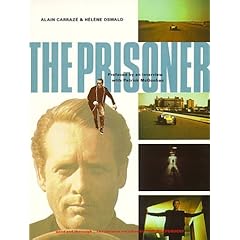
Anyhow, one of the first published prisoner books was this French one and the authors were even able to obtain interview time with Patrick McGoohan, which is more than any of the English-language book ever managed to obtain. In 1977, Patrick McGoohan had made it very clear (in his TV interview with Warner Troyer) that he had intended to make and did make 17 episodes of his show. By 1989 however, the Prisoner fans had re-written this history to suit their own version of the past. This passage, from the 1989 French book is fairly typical of the cult-fan version of the events:

“A year after going into production only 13 episodes had been made (whereas Man in a Suitcase had completed 30 episodes in an equivalent period). Moreover rumours about McGoohan’s erratic attitude were beginning to circulate. Four more episodes were ordered in a desperate attempt to make the series saleable”

Quite how the authors came up with this *explanation* is only explicable because they were deeply informed by the version of events formulated by the cult consciousness over the previous decade. By 1989 of course, we are 22 years along from the actual events and 12 years on from the start of the cult.

Those in control of the present had also taken control of the past.
As with most prisoner books the authors were misleading their readers anyhow.

Researcher Andrew Pixley has confirmed by archival checks that:

Man in a Suitcase began it's primary shooting schedules in August 1966 and by the end of April 1967, there were 16 episodes ‘completed’.

The Prisoner began its shooting schedule work in September 1966 and by the end of April 1967, there were 13 episodes ‘completed’

A negligible difference, completely the opposite to the story related in most *authorised* books. The story of the two shows thereafter was very different, but this was by design, not by accident or circumstance. Man in a Suitcase production continued through the summer of 1967. The Prisoner production stopped after April and was not re-commenced until August 1967.

The main contention of prisoner fan books concerns the reasons for number of episodes being 17 and the quote from the French book is typical of them. They have derived a notion that because a block of 13 episodes formed the first part of the production process that there was an intention to have a further 13 and perhaps even another 13 after that. McGoohan, in 1977, had told them his truth, but as was typical of the cult fans, they simply did not believe him. They didn’t believe him about Rover's genesis and they didn’t believe he intended to make 17 epsiodes from a very early stage of production , maybe the very beginning, as he had recounted within his accounts of negotiating with Lew Grade.

In fact, despite all the fan-club rumour-mongering and their unattributable reports of off-stage whispering, there is clear and irrefutable evidence that the number of episodes had been confirmed at 17 within 1966. In February 1967 an American newspaper article quotes Mike Dann as having purchased at least 17 episodes of the new McGoohan show called The Prisoner. From the tenses implied within the quotes it is evident that Dann had first confirmed the deal before a single episode had been shot.


The Prisoner project had formally been on the boil since April 1966 of course, with the pre-production planning. There can be no doubting the pressure McGoohan would have been under. He had started his project wanting to make a seven-part serial. Under pressure from Lew Grade he increased that number by more than double. It seems that pressure continued and was even increased by additional pressure from CBS in America. In an article by Robert Musel from July, 1966 McGoohan had been quoted as saying that the series would be a minimum of 13 and a maximum of 30 and was plainly resisting what he perceived as urging to "scrape the bottom of the barrel". He wanted a limited serial, but his customers wanted MORE.....


This explains the making of the first 13 as a production block and why that block of 13 proceeded more or less the same way as did the sister series being produced by Sidney Cole. Any continued negotiation during that shooting season of 1966 did end however, and the deal for 17 was concluded. Before the August 1967 second shooting schedule ever began the number of 17 was reiterated as a certainty, with McGoohan’s clear statement that he would be making only four more episodes.

A year earlier than the Carraze book TV those Timescreen writers wrote some excellent articles about The Prisoner, but even they found themselves subscribing to the cult version of events, suggesting Mcgoohan's project was somehow whirling out of his control, so inculcated was this version of history impregnated in the whole echelon of TV history writers.
“The decision was taken to end the show prematurely in ITC's opinion and the star announced during the making of The Girl Who Was Death that the next episode would be the last, and he would write it. http://www.the-mausoleum-club.org.uk/timescreen/Trial%2012/ts12cv.htm
These cross-currents emphasise the deep-seated disbelief of McGoohan’s own accounts of the events that fans have promulgated as they pursued their own agendas of *discovering the truth*.

Lew Grade mentions the project in his autobiography. He seemed to have little problem recalling the events:

I had lunch one day at CBS....... I told them I had a project called 'The Prsioner' with Patrick McGoohan, and showed them a portfolio of pictures of the village of Portmeirion, which was the location we intended to use. "At the moment though, Patrick McGoohan only wants to make 17 episodes," I said. "How much do you want?" they asked. I told them the terms and they said we had a deal.

The story is certainly not entirely a simple one. In fact, if you're not a student of this particular conundrum and have reached the end of this blog, then you may be feeling like you've just tried to speed-learn differential equations. What is clear from this unbiased and contemporary and documented history is that some of the more extreme accounts of the production history of the show, published in books since the 1980's are plainly fictional and often misleading.

I cannot finish this Blog without giving full credit to a fellow-researcher. We first met whilst mutually disassembling the big lih about Vietnam and the cowboy episode (see one of my first blogathons). Anyhow Sheriff Tomm and I became determined to *clean up the town* and much of the previously unknown American material I have referred to in my blogrolls has been located by this young American hero, and I would like to pay tribute to his discoveries right here and now...

Yeeha! Sheriff Tomm

I do not know what fate awaits me
I only know I must be brave
And I must face a man who hates me
Or lie a coward, a craven coward
Or lie a coward in my grave

Monday, 7 September 2009

McGoohan on my mind: Where Am I? In the Village.........

In my earlier Blogs I have touched on the cult fan fixation on the influences underlying The Prisoner – such influences as Kafka, Hesse, Panopticons and Carl Jung. In a similar way the fans have puzzled over the underlying influence of where the idea of ‘The Village’ came from. Ideas have varied from the mundane,
viz. the British Butlins Holiday Camp
http://www.butlinsmemories.com/bognor/maps/1967.htm
to the arcane - viz. isolated Scottish cottages
http://secretscotland.wordpress.com/2008/09/05/inverlair-lodge-for-sale
It is actually a fairly obvious fact that The Village, like much else that influenced McGoohan, simply would have come from his own working life. Why the prisoner fans sought other *solutions* is I suppose partly due to their ignorance of the 1960's 'Danger Man' series at the time of the cult inception in 1977, and partly due to their subsequent determination to largely ignore the career of the series' creator in favour of pursuing their own agendas.

In 1964 Patrick McGoohan took on the mantle of the secret agent John Drake, once again. One of the earliest episodes remarkably links the origins of not only Danger Man, but also The Prisoner as well, in the most complete and elegant way. Colony Three was one of the first episodes of the new hour-long series of Danger Man. The briefest watching of this episode will make apparent the connections between it and the concept of a ‘Village for Spies’. McGoohan may have half-forgotten the influences himself, so much part of his own psyche must they have been by 1966; just as all the other films and plays I have mentioned, in my earlier Blogs. These experiences and his own contributions to them were inevitably part of what made him who he was, professionally, and what ideas he must have had. Indeed a correspondent once reflected to me that once a person knew the details of Patrick McGoohan’s career prior to 1966, the origins of The Prisoner became almost too obvious.. :-)).

The plot of Colony Three revolves around M9 (Drake's department) noting that many Britons have gone missing (apparently to the Eastern Bloc) and none of them have ever been heard of again. Drake is tasked to impersonate a man who has been detected as about to defect. After some adventures Drake arrives in deepest ‘Russia’, but in a strangely familiar-looking location – Hamden New Town.
I won’t dwell too long on the plot. It is familiar to many anyhow, but here are a number of lines of dialogue from the early scenes, after Drake’s arrival……..

What is this place?
Mr. Donovan will explain everything

Geography is a matter of physical illusion. Lines on a map. Words on a signpost.It’s this that gives a place it’s identity. After all, you are where you recognise yourself to be. Mr. Donovan says that all countries are countries of the mind.

Well – the layout of the village is quite simple. As you can see – we’re still building.

This village is one of our best-kept secrets

You think there are no spy-schools in England?
Of course there are.

In this village we transform our guests into Englishmen

You’re quite free to wander round the village. Just don’t go outside it.

You realise that none of the residents can leave the village – ever.

The mysteriously other-worldly place is supposed to be a home-from-home. Drake shares a room with another *defector*, but Drakes room-mate begins to revolt against the situation. It is not what he had been led to believe he was defecting for. He argues with Drake, who is pretending to co-operate whilst in fact taking photographs that will reveal the village to his superiors. The room-mate quarrels with Drake:
You wanna keep your nose clean don’t you. Look after Number One and to hell with everyone else!

Drake even suffers an *Interrogation*, proving that in Danger Man at least, "Heroes do sweat"..... You'll need to click on the photo to make it big enough to see the sweat of the hero... :-)

In another scene a young woman who has also been deceived into joining the village has a conversation about her unhappiness:

Have you settled in?
I don’t want to settle in!
Oh come now, we must all make the best of our circumstances

Later on Drake has a conversation about this tragic young woman, who unlike him, can have no hope of escape:

You’d have thought she would have realised by now
Ummm… What?
That once people enter Colony Three… they cease to exist…..


In The Prisoner series, much of the basic concept of the village comes from the ideas in this episode – especially the notion of calling the place a village, rather than a town, or a settlement, or even a colony ! The purpose of the village is of course inverted to become a prison for spies rather than a school for spies.

There is a film, made in 1960, that prefigures both Danger Man and this village. Man on a String is a moderately obscure American-made ‘exposing-Communist-Conspiracy’ Fifties-style B-movie. It contains much of the gadgetry that would inspire elements of the TV shows like Danger Man, and also the techniques of mixing stock location footage with studio-work. There were many cinema movies of this nature of course, but what makes this one stand out in the context of this particular Blog is that it involves a Colony Three style school for spies. Boris Morros’ book about his real-life espionage adventues inspired this movie.

Many elements of the movie have commonality with Ralph Smart’s Danger Man – part of the same zeitgeist. Did the screenwriter of Colony Three see this movie once? I have no idea, but the movie contains the key plot element of a top secret Soviet spy school where young Communists are converted into ‘typical’ young Americans, just as in Colony Three, young East Europeans are trained to become typical English men and women, and just as in Colony Three, the secret agent returns so that all these trained agents can be identified and apprehended later.

If you click on this picture you will see that The Prisoner may well have some arcane influence of Kafka, but possibly not the one everyone thinks of!! The final picture is of Ernest Borgnine, who plays the double-agent, speaking to the students of the Spy School, just outside Moscow. It would be nice to think that both Ernest and Patrick noted this collison of their career paths, when they met on the set of Ice Station Zebra in 1967, but I don't suppose either of them would have been aware of these cross-currents.

The Boris Morros story was a significant story in itself but merely one of many such espionage events in the 1950's and 1960's. Here are just two of them, the second would attract Patrick McGoohan's attention much later in his acting career: http://www.time.com/time/magazine/article/0,9171,824789,00.html http://www.time.com/time/magazine/article/0,9171,872180,00.html

The interlocking jigsaw of these films and TV shows reflects the statement Patrick McGoohan once made when he was complimented upon the brilliance of The Prisoner, “Just a grain of sand in the desert” he modestly demurred. He may not have consciously realised himself where his ideas had exactly come from, but there is clear evidence from his career that these ideas were all derived from the work he had been immersed in, for several years. His own personality doubtless then drew in the allegory, shading as they do all the plot-lines of his Prisoner entertainment.

It is always dangerous to draw too many conclusions from too little *evidence* but during Drake's mission to Colony Three he is assigned to the Citizens Advice Bureau in the village, where there are various instructional leaflets dotted about the walls. Perhaps my snapshot doesn't do them full justice:

But hopefully you will forgive me.

Whilst the origins of the notion of a village for spies must have some connections to McGoohan's memory of this episode, it should be borne in mind that Colony Three was one of the earliest mid-Sixties episodes, dating back to 1964. One of the final episodes of Danger Man/Secret Agent also carries very obvious nuances and influences that infiltrated The Prisoner, and demonstrate how McGoohan was able to shift so effortlessly from the first show into the next. He himself said that The Prisoner began out of boredom, but that comment should not be construed as meaning he had been idle. He was remarked as working 18hours a day on Danger Man. He would naturally hit the ground running, with renewed vigour - when Lew Grade agreed to support Patrick McGoohan's very own creation - in colour !

Moor of the next thing in my next Blog. I just have a little paper to chase first.

Be Blogging you

Monday, 17 August 2009

McGoohan on My Mind: "Ladies and gentleman, by way of introduction, this is a blog about trickery, fraud, about lies"..after Orson Welles - F For Fake

The fictional world of The Prisoner is often described as having an Orwellian vision. The factional world of the cult appreciation of The Prisoner has struck me as Orsonwellian, a new adjective I have made from the tenor of his movie, F for Fake. A reviewer on imdb described that movie as having the theme:

"The point seems to be that all of life is an illusion. The question becomes how much illusion can we buy and how much becomes offensive. We see what we want to see. We ignore the rest."

Orson Welles is also famous for inadvertently persuading many Americans that the Martians had landed in their country, back in 1938. Many historians now maintain that this famous event was in fact itself somewhat of a myth, promulgated by newspapers at the time wishing to improve their circulation. It is not surprising that Welles was still fascinated by the whole concept of the muddle between reality and reported facts as he approached his sixtieth year, back in 1973. I have wondered if Patrick McGoohan was ever similarly struck by the strange other-worldy belief system his erstwhile fan club created, when they began to examine his creation, from 1967.

If you consult any of the contemporary magazines of 1966-1968, such as those available here: http://www.danger-man.co.uk/tvtimes.asp you will find a very consistent approach to the production and direction of The Prisoner. It is perhaps best summarised by the comment Patrick McGoohan himself made to Robert Musel, the American interviewer, in 1966:

"We might have gone on with Secret Agent but the American network took so long to make up its mind we decided to close it down. I had a lot of help on that series but as star and producer and even writer of some of the scripts of The Prisoner I'll have only myself to blame if it's a lousy show."

That is not to say McGoohan was a complete egoist however. In 1977, during his interview for Canadian television, he also made the comment:

"I was fortunate to have two or three creative people working with me, like my friend that I said saw the meteorological balloon."

In another interview in 1979 he made a special point of mentioning that he had been *lucky* in having a very good crew to work with him on the show and in his final word on the subject in 1991, he remarked:

"You can't do a thing like that on your own.... I had fellows who came in on it with me. I had a script supervisor - you can't write them all yourself."

In 1989 Dave Rogers, an archive-TV author remarked upon some things in his Boxtree book, The Prisoner & Danger Man. Anyone outside the cultish Prisoner club probably found one or two things he wrote surprising (I know I did when I bought the book back in 1992). Rogers noted that a senior club co-ordinator stated that the mechanical Rover probably never existed; notwithstanding that McGoohan had spoken of it in 1977. Rogers also noted the cult contention that the entire concept of the series had been *lifted* by McGoohan from an idea of George Markstein. Mr. Rogers passed his own comment: "I find it doubtful that McGoohan had either the inclination or the necessity to lift someone elses idea". I can distinctly remember being shocked at the time, but largely ignored this arcane issue, as the author made plain it was nonsensical in his opinion too. Twenty years later, as I have increasingly taken a close interest in Patrick McGoohan's career, I have realised how deeply this issue has lain at the heart of Prisoner Appreciation and corrupted reality.

Every cult I suppose must have it's own Creation Myth but this particular one has been staggeringly amplified and refined and yet it is built upon outright non-truth. It appears to have begun around 1978/79, not long after the cult itself began. An unrecorded interview with George Markstein took place. Quite why the fan-club became so enamoured of George Markstein is unclear to me but perhaps it was the delicious discovery they made that the bureaucratic little man seen in the opening of most episodes was in fact none other than the Script Editor himself!

This is the sort of previously-unremarked detail that any cult would delight in discovering. The eddies and vicissitudes of fan interest take many a twist and turn but certainly by 1988 the books that began to appear were referring to George Markstein as a co-creator or even the originator of the whole idea! Other credits, both in published books and across the internet refer to the Script Editor as a Producer or even an Executive Producer! In one particularly appalling piece written in Zani magazine, shortly after Patrick McGoohan had died, the story was amplified to say that George Markstein ran the project until usurped by McGoohan. This tosh is written despite the fact that Everyman is known by every man and every woman to have been a production company owned by Patrick McGoohan and David Tomblin, whilst George Markstein was one of their employees !!

Mr. Markstein died sadly young, in 1987, so certainly these vainglorious titles cannot be laid at his door. His promoters have been busy on his behalf however. You, as an accidental tourist on my Blogroll may in fact have accepted these *facts* as *Gospel* up until now. I cannot blame you for that. When untruth become repeated and remain unchallenged they start to become accepted fact I guess. However, if you are curious enough, I would like to address some of the *official* facts about this whole matter and offer a few observations and facts to prompt you to compare those *official* version to your own logic as well as to physical history and circumstance. I pick on the most recent *official* book, but you may find much the same drivel in many of the earlier ones.

Page 472 commences confidently: "George Markstein was born in 1929.......
but it's own internal logic collapses almost immediately as this further statement is written:
"...... he was a useful asset to the US Forces magazine 'Stars & Stripes after the defeat of the Third Reich"
Anyone capable of arithmetic can work out that these *facts* make Mr. Markstein aged 15 in 1944, and patently a 15 year-old boy would neither be a journalist nor an asset to the Allied Armies bent on clearing up the after-effects of the Third Reich! He may have kept a diary as did Adrian Mole of course, but that has yet to be mentioned in prisoner lore.

Furthermore, Markstein never worked for the famous Stars & Stripes, a fact that their archivist was only too happy to confirm by e-mail to me recently. http://www.stripes.com/webpages.asp?id=23 The archivist was able to inform me that she did know of George Markstein however, as he wrote a humorous London-based column for a different magazine called "The Overseas Weekly" in the 1950's as well as being known under another pen-name: George Mark. What is remarkable is that in the book from 1989 that I mentioned earlier, Dave Rogers noted that Markstein had worked for The Overseas Weekly. The *Official* books had already consigned known fact to the dustbin as they pursued their preferred version of history..

The supposed authoritative *official* text continues:
"Working with the various allied armies... in post war Europe... Markstein's fascination with espionage blossomed"

Have I said enough about this arrant nonsense? Perhaps not. Where has this information come from? Its has clearly not come from the magazine Star & Stripes because Mr. Markstein never wrote for it. The place it came from was the cult fans who began to laud the script editor around 1980, as the *official* book has the decency to make plain: "Eleven years after the first showing George... was invited by Six of One... to speak.... " Interestingly, prior to this, in 1976, George Markstein had announced his own resignation from TV drama; this was after his successful novel in 1974, which took the ideas that McGoohan had used, of a person being spirited to a velvet prison. Mr. Markstein employed them in the first of his reasonably popular novels entitled 'The Cooler'. Mr. Markstein is pictured looking fairly glum, and has an acid opinion of British TV drama, ten years after The Prisoner.

If you read the most recent *official* book it describes George Markstein as not only having come up with the original idea for what many regard as the most unpredictable series ever made , but also a man who had been rankling with rage over his failure to receive proper credit (and Royalties) for that landmark series. In what was a three page article, and effectively his *resignation letter* ...... Mr. Markstein never once mentions either The Prisoner, nor his own ire about his being *passed over* - not once, not even a hint.

Interestingly, in 1982 he dismissed the programme to some of the very fans who consider he *created* it: "I think it's very sad, it's a sad commentary on the state of television that we have to revive something like this." http://www.the-prisoner-6.freeserve.co.uk/markstein.htm Mr. Markstein and his sour attitude about TV had plainly not altered much since 1976. If you read that web-logged interview btw, you will also notice that at no point does the Script Editor make any claim for his origination of the show, he suggests at one point that he acted more as a story editor than a script editor, but that is all he states in public.

Returning to the 2005 *Official* book there is this further gem of a fan-fantasy:
"Markstein...., as a military journalist who travelled in Europe extensively, may well have been a spy himself"

There is no evidence whatsoever that Markstein ever set foot in Europe in this way. The 'Overseas Weekly' was based in Frankfurt but George Markstein is noted as the rather grandly-titled 'London Bureau Chief'. One reference to him I have located in an obscure article mentions him as a pupil of Westminster School, a major private school in London. If you read the *official* account, Mr. Markstein, it is implied, narrowly escaped being caught up in the Nazi Holocaust and suffered *hardship* in his early life. Instead, he may well have been a pupil at one of the most privileged schools in England.

Once again it was fairly simple for me to find out that Markstein was basically a jobbing journalist, learning his trade throughout the 1950's. He worked in the 1950's writing for a staff magazine serving the US Third Airforce base, in Ruislip on the outskirts of London. Why would the fans have believed Markstein was a spy or worked in Europe with the Allies, dismantling the apparatus of the Third Reich? Mr. Markstein patently never did any of this. Did he tell them he had done these things? I have no idea but he had managed to write a book by the time he was 45, so he had learned to tell a good story I guess. If the gullible fans who have since created these legends about him had done the slightest research, they would quickly have realised their stories were nonsense. In the world of the cult however the orsonwellian truth is that: We see what we want to see. We ignore the rest .

The official book continues to pile up the cards into a veritable tower-block, never mind a house. ".. 1961. Four years later he got to put his wartime experience to good use on the WW2 series 'Court Martial'."
Wartime experience? Which war? The Korean War? Even the *official* historians don't seem to have this globe-trotting writer/spy/journalist in the Far East. The inept and stupid *official* facts don't even require you to believe the Moor Larkin version of history. The *official* account is inane. Markstein put his experiences of wartime to good use? The Blitz in London would have been the only war he saw and he was barely twenty years of age in 1950. By 1961, George Markstein, was working for The Marylebone Record, a local newspaper in London. Within a couple of years he would begin to get his articles printed in the prestigious TV Times, a pattern that would lead him, by 1965, into the sphere of one of the most celebrated TV actors in the world at the time.

While Mr. Markstein was penning erudite articles for the Marylebone Record, Patrick McGoohan had an appointment to address the Television Writing School, in London, to lecture writers about *actors requirements* from them.

Moor bloggering about next time.......... Unofficially................ Be Seeing You.

Tuesday, 9 June 2009

McGoohan on my Mind: Secrets, Agents, Ducks, Drakes and Get Smart

In my first blogjob I made my own arrogant comment about the arrogance of Fans. Nothing demonstrates their 'Day of the Locust' nature more than the conundrum they came up with, when they attempted to link fiction and fact, fed only by stupidity and ignorance.

Like me, many fans may be old enough to remember the character who made Patrick McGoohan so enormously popular with TV viewers in the early to mid 1960's. He was of course John Drake. Despite being enormously popular, by 1966 the writers were running out of stories and the the secret agent boom in America had led to so many competing programmes (such as Man from Uncle) that whilst the writers were struggling to write on their paper, the writing was clearly on the wall, so far as John Drake was concerned. CBS delayed renewing their contract with ITC as more and more American product came on-stream and judging by the final two episodes of 'Danger Man'/'Secret Agent' that were made, both budgets and production values were being sacrificed as ITC sought to find an economic way to continue the series. Ralph Smart left the reins of the show prior to the two colour episodes, and Patrick McGoohan, who by then had some considerable influence over Lew Grade, also abandoned the project. Sidney Cole went on to make 'Man in a Suitcase', the sequel to 'Danger Man'/'Secret Agent' ' in which poor production values were ever more apparent and mayhap contributed to it's failure to penetrate the US market. Meanwhile McGoohan of course (as we all know!) had obtained funding from ITC for the company he owned, along with colleague, David Tomblin, called 'Everyman'. The fact that McGoohan's name could by that time sell pretty much anything from hats to gravy powder, is evidenced by the opening titles to the show that his company Everyman, would produce. This is the first frame we see, after the famous 'resignation' sequence.


It was a guarantee of a significant television audience and 11,000,000 people in Britain and later, 25,000,000 in America duly tuned to watch 'Arrival'. Not surprisingly, many of us watching at the time saw John Drake resigning and being kidnapped and metamorphosing into Number Six. But metamorphose he did. The usually angry, constantly combative and often downright bloody-minded character who raged about the Village was no more like the calm, friendly, sympathetic John Drake, than the cynical, amoral David Jones (from Ice Station Zebra) was like the Danger man. However, as McGoohan once remarked himself, they all did look somewhat alike!! Well aware of the likely confusion and possibly anxious to resolve it, in the viewer's, and the media's minds, Patrick McGoohan's company made the situation very clear right from the beginning, as can be seen in this ITC Press Release from 1967.

In interviews McGoohan admitted that he retained the 'secret agent' milieu as a fundamental part of the plot of The Prisoner, as that was what he was known for at the time, and naturally he wanted to carry his audience with him. Perhaps he could be accused of wanting to have his cake and eat it but certainly he made no attempt to disguise what he was doing. He confronted the fact he was well-recognised as the agent of M9, and then explained, so far as he could without giving away any more of his plot than he had to, that his new character was not John Drake. There are magazine articles declaring "John Drake died in London....". One of them, from New Zealand, is here: http://www.danger-man.co.uk/docs/magazines/tvweekly/Aug1966/pdf.pdf
Fast forward to 1977 and of course, many in the fan society would naturally be ignorant of the history, and so, as they searched for the meanings they saw in the programmes and the allegories and hidden references, they naturally became entranced with the idea that the secret agent who resigned was John Drake. They seemed to know little of the character that was John Drake (a problem now resolved by the issue of the old shows on DVD) but of course they had seen the old press images of Drake, as used in the visuals of The Prisoner.It was obviously the same man. Then, in 1984 they had it confirmed for them by the Script Editor: "

Well, 'Who is No.6?" is no mystery - he was a secret agent called Drake who quit."

and so the fans, hungry for intrigue,mystery and conspiracy were off and running. Plainly, Mcgoohan's denial that Six was Drake was all part of:

"later myths built up about the series built up by McGoohan in his presentations before the North American college students. " see my previous blog

And so a curious amalgam of supposition was constructed. It goes something like this:
McGoohan denies Six was Drake. Six looks and sounds like Drake. There are pictures of Six, that are definitely Drake. Six seems to be a resigned secret agent. Drake was a secret agent. Markstein, who the Fan Dome tout as a creator of the show says Six was Drake. How do we resolve this conundrum? What could the reason be? Ralph Smart was the acknowledged creator of John Drake, so the reason must be that McGoohan would have had to pay Ralph Smart Royalties! Conundrum resolved!
In one fell swoop the Fan Dome label McGoohan as not only a tad deceitful, but mildy plagiaristic too and perhaps a little sneaky......... They seem generally oblivious to this character assassination however and so great is the enthusiasm for this myth/legend that you will find it detailed in many books on many web-sites to this day.

When I first read the *theory*, it caught in my personal craw, but for quite some time I ignored it (as with much else I read in the prisoner world). What did I know? Then, I realised that there was copious evidence from 1966/67, such as the articles I quoted above that demonstrate that McGoohan was totally open about the feasible Drake link and it's possibilities, from the beginning.

Then I began to wonder what the fans knew about Ralph Smart. I discovered that in fact nobody knew anything about Ralph Smart....not even the supposed *historians*. The whole 'Royalties' theory was a house of straw - sheer (uninspired) guess-work. Doing my own research suggests Ralph Smart was probably not the owner of any supposed copyright anyway. The brand 'John Drake' was in use all over the world, and there seems no suggestion that the money for this went anywhere other than ATV/ITC, to be no doubt divided between the likes of McGoohan and Smart as applicable in their contracts. Ralph Smart was directly employed as a Producer by Lew Grade. It is even unclear that the 'brand' was copyright to anyone. McGoohan's face and the John Drake name continued to be used for a pulp magazine in Germany right into the 1970's. I daresay nobody outside German pulp-fiction readers even noticed.

Whilst I had no more access than anyone else to any confidential, arcane, financial contracts, I could see no justification for the McGoohan/Drake/Smart Royalties myth and then I finally found something that linked Ralph Smart and The prisoner very directly, and quite personally........... I discovered the clearest possible evidence from The Prisoner show itself, that the whole legend was a pile of ripe cheese.

The very first person Number Six meets, after his arrival in the Village is the waitress, an actress familiar to McGoohan from his days in Danger Man.

The actress is Patsy Smart......... No coincidence.

Patsy was Ralph Smart's sister, with whom he was on good terms, all her life.

So, to revisit the grand Drake/Smart/Royalties theory: we are supposed to believe that McGoohan machinated to deceive/swindle Ralph Smart and apply deniability to any use of his *copyrighted* *licensing* entitlements

[sarcasm]................. Then, he took Ralph's sister with him for the long Location Shoot, to Portmeirion, where she could socialise with all his and her colleagues, and pick up all the gossip........... Not content with that, Patrick McGoohan was then so cold-blooded, that he deliberately made Ralph Smart's sister the very first character his new Number Six happens to meet ............. [/sarcasm]

Far more likely is that McGoohan was *waving goodbye* to his former mentor, in that quirky in-joke way he utilised throughout The Prisoner, a wave of thanks and appreciation. Thanks for the past, this is my little tribute to you, for the future........... But this last is a myth of my own making............

It does seem to me however to suggest - perhaps quite strongly - that whilst the viewer may enjoy making Six Drake and Drake Six, it is not six of one and half a dozen of the other. It is patently clear that no deception was intended or carried out. It was also patently clear by Patrick McGoohan's constant and strong denial of this *theory* that he was somewhat offended by the notion. The fact that fans come up with such specious and unresearched ideas/theories/myths seems to say more about their characters than the characters of Drake, Six....................or Patrick McGoohan.

Readers of my Blog can of course aver otherwise, in the relevant comments boxes....... If nothing else, it can be a Confessional............. But that would bring us to the supposed religious elements conflated into The Prisoner, from the actor's own fan-alleged opinions. Notwithstanding the Fan Dome insistence that he was *deeply religious* (an opinion expressed in even the most recent tomes) Patrick McGoohan explained in moor than one interview that he was, in fact, no such thing...............

But who was listening? Or reading?

Be seeing you............

Sunday, 7 June 2009

McGoohan on my Mind: Clubs Cults Heroes and Villains

In 1982 Patrick McGoohan was persuaded to appear on a "Best Of" TV show. He happened to be in England at the time http://www.youtube.com/watch?v=F8-cp2yb43c and his somewhat bohemian appearance is explained by the reason he was in the country at all. He was filming Jamaica Inn, a three-part TV film, with Jane Seymour. In order to play the wicked Uncle Joss he had grown long hair and sported stubble daily.

No doubt however, his ruffled appearance, in comparison to the debonair dress of John Drake or even Number Six, delighted fans by then becoming convinced that their idol did in fact have feet of clay. It is interesting to note that, whilst surrounded by his apparently adoring fans, McGoohan makes an opening statement that seems to be almost hyperdefensive:

"I suppose I did a fair amount of things. I was executive producer, I wrote a number of them, directed a number of them, thought it up."


The casual viewer, such as I, might have wondered, Did anyone doubt this? After all, this had been clear right from the beginning hadn't it? Going back to my second Blog-post, you can read the articles from 1967 and 1968 that make clear that the entire project was McGoohan's and he also welcomed full responsibility for it, whether the viewers had liked it, or not. By 1982, the fans had been studying the show for five or six years for themselves and in fact, the very people who feted him, were also by then, denying him. Beneath the Fan Dome, unbeknownst to the rest of us, living outside their arane meanderings, 'discoveries' were being made................


How do we know who to trust?


had been one of the questions the earliest Conventioneers had been asking themselves and they had decided by this time that Patrick McGoohan was not to be trusted. One prime example of this UnTrust concerned one of the most striking 'characters' of the series, Rover - the roaring, stifling guardian of the Village. Back in 1977, just as the fan clubs had been getting themselves off the ground, McGoohan had explained the mildly convoluted tale of the genesis of the inflated ego that was Rover, to his equally egotistical audience


We had this marvellous piece of machinery that was being built which was gonna be Rover and this thing was like a hovercraft and it would go underwater, come up on the beach, climb walls; it could do anything. That was our original Rover.


On that occasion it was clear at least one of the audience could not credit McGoohan's relaxed explanations,


What interested me was the style in which it was done and the whimsy and the hundreds of little touches, but from everything you've been saying so far, they all seem to have been accidents. You know, the white balloon was an accident and you happened upon the Village...
McGoohan: Oh, yeah...
And it's, you know, incredibly lucky.
McGoohan: Yeah, but you...no, no, no, no...There were these pages, don't forget, at the very beginning, which laid out the whole concept; these forty-odd pages laid out the whole concept. That was no accident.
No, but the little touches...
McGoohan: Those things come anyway.
But I haven't seen them come very often in any other series.


The doubters were not to become any less doubting. In fact, for a number of years thereafter many fans wholly disbelieved McGoohan's story about the beginning and end of the 'original' Rover. They simply chose to disbelieve him. This disbelief in fact surfaces as late as 1988 in the Official Prisoner Companion. The book mentions the story McGoohan told, but then suggested that as no evidence had been found by fans to substantiate his tale, it was probably untrue. It was not until the 1990's, when archive photographs of McGoohan's fabled machine were located, that the fan clubs grudgingly accepted that the creator of the show had in fact been right all along. Like any good Number Two however, I've never come across any apology for their decade-long denial of what McGoohan had told them. Of course, in as diffuse an organisation as the Fan Dome, each individual can blame another and say that they personally had never doubted the story for a moment. In fact, in 1988 itself, another researcher, this one focussing on original scripts he had access to, had also backed up McGoohan's tale of a mechanical Rover in a non-Club fan magazine called Time Screen. However this magazine lay outside the organised Appreciation Society and no doubt because it fell outside their doctrine, seems to have been ignored because it was not until the photographs were unearthed that the Fan Dome finally capitulated and re-wrote this piece of their Official reportage. By then of course the doubts about Rover and especially McGoohan, were legion.


I have laboured this one example a little merely to demonstrate the way the Fan Dome insisted on interpreting the reality of the creation of this amazing series, just as they had liked to interpret the allegory and meanings of the fiction of the shows themselves. As always in this form of group-think, what was actually happening was that a very few individuals were doing the thinking and the majority were doing the voting. In a remarkable fascsimile of the themes of the shows themselves the Villagers and their Number Two's pursued a relentless campaign against the recalcitrant Patrick McGoohan, who generally refused to give them his reasons, but just as in the Village, when, on those rare occasions he did give in and try to explain his story - they refused to believe him !! I would say you couldn't make this stuff up, but of course Patrick McGoohan had made it up - in 1966-68 !!


In a remarkable piece of double-think the Fan Dome authors would reproduce original brochures, such as the one below, for members to collect, the brochure stating categorically whose show it was (read it below and weep tears of laughter or sorrow, as you see fit), but within their own Committees, they would formulate their own preferred versions of history and simultaneously would dismiss such archive documents as mere ITC propaganda.


It was a well-worn path, and one that ironically had probably influenced the mind of McGoohan himself, when he first began to formulate his ideas for The Prisoner. It involved calling for witnesses.

As can be seen from their records http://www.portmeiricon.com/timeline.htm the Appreciation Society had a regular and full calendar of events. It is clear that without this fan society, subsequent interest in The Prisoner would never have perhaps become as intense as it did. I say perhaps because in 1984 The Prisoner was chosen as a 'big gun' in the first year's programming of the first new TV channel in Britain since 1967. The channel had begun a year or so before and as part of it's governmental pledge to appeal to viewers not catered for elsewhere, it had begun broadcasting old shows not available for years. An interesting blog about the circumstances surrounding the documentary made to accompany the series broadcasts, "Six Into One:The Prisoner File", was made here, http://www.illuminationsmedia.co.uk/blog/index.cfm?start=1&news_id=201 after the death of Patrick McGoohan this year.

The resultant interviews that were held with the 'big guns' of the series itself have since become essential reading for fans, but these interviews derived from the documentary TV makers, rather than fan society interviews. However the fans had already interviewed many personnel involved in the series themselves, including Patrick McGoohan himself, as early as 1979 and George Markstein in 1980. These interviews had highlighted a major schism for the fan society to reflect upon. George Markstein apparently made it known to an assembly of fans at London's ICA to watch Chimes of Big Ben, that he in fact was the real creator of The Prisoner. I say 'apparently' because there has never been any release of this interview on tape or video, or any transcript published. The 1979 interview with McGoohan was widely disseminated on cassette tape and currently CD. As a result the differing tales to be told have never been compared outside of fan circles.

In 1984 the undercurrent to this controversy was revealed when Channel 4 broadcast the interview that they had held with George Markstein, and also the one they held with Patrick McGoohan. The interview with Markstein has been transcripted for many years here: http://www.the-prisoner-6.freeserve.co.uk/markstein.htm and within that transcription, this comment has been added by the webmaster: Patrick McGoohan was also interviewed for the programme. His attitude was "If Markstein's in it, I'm out!" Again an indication that the two men had not parted friends. McGoohan was eventually persuaded to film his sequences and these were brought back to London and edited in, but he withdrew his permission just before the programme was ready to go on air. Chris Rodley, the producer, took a brave decision to go ahead and screen it anyway. The assumption by the webmaster of this now long-standing website is an interesting one, for he assumes that McGoohan's animosity stemmed from the time of The Prisoner. In fact, it seems much more likely that this animosity stemmed from the attentions of the fan society to Markstein's claims in the 1970's and 1980's, after Markstein successfully published his reworking of the prison without bars plot outline, as the novel, The Cooler, in 1974, and then first began to claim to be creator of The Prisoner, when prior to that, he had only been known as the Script Editor who had left the series, (along with several other personnel after the first tranche of 13 episodes). His public claim only amounted to a brief note on the flyleaf of his book and it is interesting to note the ambiguity of his interview referenced above, where he never actually claims to have been a creator of the idea, but does increasingly suggest that his ideas were what drove the narrative. Future blogs here will point out that this notion is nonsensical when regarded against the actual sequence of events as the series actually began production.

Later blogs will also take a look at who exactly George Markstein was professionally, prior to his association with Patrick McGoohan. Curiously, even those fans who claim to have known him personally and with whom he shared his anecdotes, seem to know nothing about his past achievements prior to his jobs with ITC. The makers of the Channel 4 documentary also spent some time with Markstein and their 'private' reminscences have also coloured Prisoner writings since. Very little of all this intrigue has ever become publicised by the fan societies. Instead a melange of hints and internet nudging and winking has infested the subject.


This small review was published in 1974, to tie in with his novel launch. In 1976 Markstein was to retire from television writing and wrote a long article about how disillusioned he was with the whole situation for writers in television at that time. It is interesting to note that other than his half-credit for 'Arrival' (alongside David Tomblin), Markstein wrote no episodes of The Prisoner. His only other writing credit prior to The Prisoner was one of several names on the movie 'Robbery', also made in 1967. Moor of all of this enigma at a later date. For now, I must return to 1984 and the controversy surrounding the programme, Six Into One:The Prisoner File and of course, the story of the reality of the production of the show itself and what that can tell us about the real story and the creation myth. By 1990 this controversy had led one author to write:

"........However Gold's information appears dependent upon later myths built up about the series built up by McGoohan in his presentations before the North American college students. Rodley's source of information appears more accurate (confirmed also with George Markstein in conversation) ............"