Showing posts with label The Prisoner. Show all posts

Saturday, 20 March 2010

McGoohan and the Rehearsed Mind from Moby Dick: It was the whiteness of the whale that above all things appalled me.

What is it that in the Albino man so peculiarly repels and often shocks the eye, as that sometimes he is loathed by his own kith and kin! It is that whiteness which invests him, a thing expressed by the name he bears. The Albino is as well made as other men- has no substantive deformity- and yet this mere aspect of all-pervading whiteness makes him more strangely hideous than the ugliest abortion. Why should this be so? - Herman Melvillle - Chapter 42 - Moby Dick

In my last Blog I mentioned the observations of the first academic *students* of The Prisoner and their bemusement about how so much of the series seemed to have occurred *by accident* or *by chance*. The story of the genesis of Rover seemed so absurd to the Cult Society that arose in Britain, that they declined to believe the story McGoohan told. However the coincidences of Rover are both mundane and elucidatory in equal measure. Perhaps most intriguing is the fact that the original plan was to have a domed wheeled machine (British fans for some years maintained this machine never existed and was just another tall tale by McGoohan). The drift from an egg-shaped machine to an amorphous egg that in turn lent itself to a mimickry of the bubbles from a then very fashionable lava-lamp is a progression that happened by chance, yet on the other hand it is easy to see the *train of thought* by imaginative minds. The allegorical ideas McGoohan was keen to employ are in some form perhaps first demonstrated by this happenstance. Was he also carrying the notions of Moby Dick's baffling chapter, "The Whiteness of the Whale", from which my prefacing quote stems ? These comments by a fellow of the Blogosphere might strike a coincidental chord in anyone who has read some analyses of the nature of Rover, from The Prisoner :
http://ladderonwheels.blogspot.com/2009/11/whiteness-of-whale.html
If you ever read Herman Melville’s Moby-Dick for a class and want to make your teacher very, very angry, try to steer every conversation around to the “meaning” of the white whale itself. Your teacher won’t appreciate it, but you’ll just be following the early trends of Melville critics, for whom the whale absolutely must have represented some huge secret to the meaning of life. Is it God? Evil? Purity? Humanity? Sin? Sexuality? You name it, and someone’s proffered it as the secret meaning of the novel.

Mere coincidence? The story-book from The Girl Who was Death has another....

Anyhow, the mechanical Rover was seemingly abandoned by the owner of Everyman without a second glance - the *new* Rover gave him far more allegorical scope and he grasped the chance. Many years later Patrick McGoohan would explain to an interviewer:
I don't know how to plan. For The Prisoner, for example.....When we discussed a design, I told him what I had in mind and he translated it onto paper.......... We understood each other marvellously. And that's the best way to work. If there's enthusiasm and the team feels it's being directed by someone who knows what he wants, then all that enthusiasm goes into good work.

At least one memoir from one of the colleagues of McGoohan's recalls McGoohan being enamoured of the book The Outsider, by Albert Camus. However, McGoohan himself, when questioned about books such as The Glass Bead Game responded that he didn't read "that sort of stuff". Is it mere coincidence that a book called The Outsider by Colin Wilson - classed as one of the original Angry Young Men of 1950's British Theatre - had been a best-selling book in England, and was something of a potted biographical study about the "men in isolation" throughout history? McGoohan did admit to liking biographies. Was the title on the spine of a book misunderstood by this coincidence of titles? If you have never heard of this other Outsider, one of my earlier blogs deals with it here: http://numbersixwasinnocent.blogspot.com/2009/10/mcgoohan-on-my-mind-episode-18-angry.html

The Glass Bead Game is the source of another cult myth. Prisoner writers have claimed that the *hero* of this book was named Joesph Serf, but in fact he wasn't. The character was actually named Josef Knecht. They often just make stuff up.


The name Joseph Serf is evidently a play on the self-mockery of McGoohan himself. Growing up as the eldest brother of several younger sisters one can imagine the adolescent sighing wearily to his mother (who he remarked liked to call him Patrick-Joseph), "It's okay Ma, Joe Serf will do it...", when yet another heavy chore needed to be done by one of the children.

Another coincidence has become muddled in the interpretations of John Drake transmogrifying into Number Six. In America, the title-song famously reads:
Secret Agent Man.
Secret Agent Man.
They've given you a number.
And taken away your name.

Some observers have since wondered if this ditty even was part of the inspiration for McGoohan's later use of the idea of a man with no name. It's quite possible this coincidence fed into his train of thought - he was certainly aware of the song, as recorded in the article about he and Peter Falk from 1965, in my previous Blog to this one.

So why did PF Sloan write such a line for Johnny Rivers to sing? Another coincidence might explain it. In 1965, when the hour-long adventures of John Drake were sold to CBS, the pilot episode was to be Battle of the Cameras. It would make sense that in order to help Sloan to figure out a theme-song, CBS would give him a preview of the show itself to watch, to get a sense of the style and characters. In the opening scene of this US debut episode an agent is introduced to his superior and identifies himself as Agent 1056. One can imagine this numeralisation adding to the resonances already of Agent 007 and sticking in the song-writers mind - the agents in Danger Man were normally spoken of by name, so this is a striking coincidence, and an interesting example of how effect and cause can sometimes be very difficult to unravel. Was the number 7 also deliberately made absent in The Prisoner by McGoohan as some small injoke about the most famous secret agent's number? It made it ironic that Number Six drove a Lotus 7 of course, too.

Was it mere coincidence that the first character Number Six speaks to in the village was Ralph Smart's sister, Patsy? http://numbersixwasinnocent.blogspot.com/2009/06/secret-agents-ducks-drakes-smart-people.html I can imagine the blog reader is beginning to find all these questions are a burden, but perhaps by asking the questions I also supply an occasional answer that makes more sense than the cult stories about McGoohan, Royalties and the Smarts.

One of the principal cult leaders released a careerography of Patrick McGoohan a year or two ago. He touches here and there on some of the contested elements of the genesis of The Prisoner. Privy to the unpublished but widely whispered sayings of George Markstein, this writer [sic] quotes the Script Editor on page 110: "I decided to call him Number Six because it's high enough to make him important and low enough for him to get pushed around" A reasonable enough comment, and possibly one I could have made up myself, but from the man who claimed to have researched a mysterious Scottish location from WW2, it seems curiously bland and inconsequential in view of recently published WW2 history. "One answer was to be found at the eighteenth century Inverlair Lodge, nicknamed 'Number 6 Special Workshop School' in Scotland" http://europeanhistory.about.com/b/2008/09/12/britains-failed-ww2-spies.htm

It seems curious that if Markstein had indeed secretly researched Inverlair, as he claimed many years later, that he had not noticed the curious coincidence of the number allocated to the prisoner himself and the name of the establishment. It is of course my contention that Markstein made these decade-later post-hoc claims merely to accumulate kudos amongst gullible prisoner fans, who applied very little, if any, study to the facts behind his stories. I had to grin at another passage on that same page where that writer writes: "[Markstein] insisted that he came up with the concept of The Prisoner at 6.21pm one evening, while travelling on a London train between Waterloo and Shepperton Studios." No researcher can claim to be able to read the mind of a man but like the fictional Sherlock Holmes, a mere browsing of Bradshaws would reveal that as George Markstein lived in Bayswater, why would he be travelling from Waterloo ? Perhaps simple ABC provides the answer: B=Shepperton, C=Bayswater and A=Waterloo. I daresay sooner or later we might need a D.

You may think I'm making a bit of a conspiracy here. Why should a man not have a reason to travel from Waterloo to Shepperton one day, instead of from his home in Bayswater? An earlier quote from the mid-1980's Prisoner article, 'Inside Out" however carries a curiously coincident resonance: "George Markstein first heard about the project's acceptance on the railway journey between Shepperton to Waterloo" so there is certainly a pattern in the story-telling, if not the route logic. My next Blog will be about Inverlair because this establishment is often quoted nowadays in references to the origins of The Prisoner, but it really does seem to have become something of a Scottish red Herring.

The mysteries of the origins of Number Six and the coincidences thereof could even go back to Patrick McGoohan's schooldays. The careerography quoted above mentions that the young McGoohan joined the wartime ATC at Ratcliffe Aerodrome, which was next-door to the school. Remarkably, however it failed to notice the curious coincidence that: ....Ratcliffe started a new career as No 6 Ferry Pool for the ATA........ http://www.airclark.plus.com/RatAerodrome/Rataero.htm

Enough already !! I can feel my blog readers head spinning with the happenstance of numbers. I will return to the theme of how things cannot always be purely coincidental however, in my next Blog, but in the meanwhile it might be worth mulling over the notion that, "There are no coincidences Delia, only the illusion of coincidence.” and the coincidence that the line comes from a movie called, V for Vendetta.

Sunday, 7 March 2010

Mcgoohan: It's all in the Mind: from what you've been saying so far, they all seem to have been accidents. And it's, you know, incredibly lucky.

Ten years after The Prisoner had been first shown, Patrick McGoohan was interviewed in Canada, where his old show had prompted an academic study to be made of it by TV Ontario, designed for courses in Broadcasting - perhaps Media Studies, as we would now call it. McGoohan was no doubt billed as the man with all the answers, but it was clear his audience found his answers infuriatingly vague. They were of course pursuing their academic study and as he was the named creative force they had read about, then they seemed to expect him to also be their teacher. Instead, at times he seemed to tease rather than teach, prompting this exchange:

Boy: What interested me was the style in which it was done and the whimsy and the hundreds of little touches, but from what you've been saying so far, they all seem to have been accidents. You know, the white balloon was a accident and you happened upon the Village...
McGoohan: Oh, yeah...
Boy: And it's, you know, incredibly lucky.
McGoohan: Yeah, but you...no, no, no, no...There were these pages, don't forget, at the very beginning, which laid out the whole concept; these forty-odd pages laid out the whole concept. That was no accident.
Boy: No, but the little touches...
McGoohan: Those things come anyway.
Boy: But I haven't seen them come very often in any other series.
McGoohan: But they come because you're looking for them, you see. I was fortunate to have two or three creative people working with me, like my friend that I said saw the meteorological balloon. And wherever one could find these little touches, one put them in. But the design of the "Prisoner" thing, that was all clearly laid out from the outset.
Boy: And the style of the way...
McGoohan: And the style was also clearly laid out and the designs of the sets, those were all clearly laid out from the inception of it. There was no accident in that area, you know, the blazers, and the numbers and all that stuff, and the stupid little bicycles and all that.


He also did little to ingratiate himself with his putative fans with such comments as: "stupid little bicycles" !

The more one learns about The Prisoner the more one is drawn to realise that it was very much a flow of his own consciousness. A constant refrain from interviewed cast and crew over the decades since is the comment to the effect that "nobody knew what was going on!" and even some who added that they didn't think McGoohan knew what it was all about either. In my earlier blogs I have explained some of the possible backgrounds to how the show came to be made in the way that it was. However the role of coincidence and chance should not be under-estimated. I was reminded of this when I came across this newspaper-clipping from 1965.

Newspapers often get things wrong and in 1965 the journalist felt that Patrick McGoohan and Peter Falk would not make good bookends...... well, forty years later we know the truth about that particular conundrum:

This article, from a newspaper dating from December 1965 coincidentally also tells another truth, but a truth that has been largely dismissed by most *Official* Prisoner writers over the years of analysis since:

McGoohan's future plans include "four feature pictures in hand and another TV series. I won't be in it, but produce it instead"

To read most *Official* accounts of the planning and making of The Prisoner, the reader may conclude that Patrick McGoohan resigned *on a whim* from Danger Man one day and lurched desperately into another TV show that he hoped would continue for several seasons. McGoohan himself contradicted this view in its entirety in almost every interview he gave over the ensuing decades. However any self-respecting cultist must have a conspiracy to pursue and so his protestations largely fell on deafened ears within the cult of The Prisoner. Not that he could care less. As he remarked laughingly to his French Prisonographers in 1990,

"I had the chance to do something nutty so I did"

National pride is also invoked amongst many of the opinionated explanations of The Prisoner and its genesis, production and conclusion. British fans largely discount the influence of the American market and yet it is clear from this clipping that the American TV market was instrumental in the ending of Danger Man/Secret Agent:

The continuation of our series is really very dependent on the American market," said McGoohan, "We sold CBS 22 episodes and would like to sell the network 22 more."

But by 1966, the Secret Agent craze had led to home-grown American series' and the adventures of John Drake had in truth run their course anyhow - casual viewing of the final two episodes made (in colour) reveal an increasing paucity of ideas and ITC production values cruelly exposed by colour film. McGoohan used his commercial muscle to launch something new. He was deternmined that not only would his new show be full of fresh ideas but also that they would be made in a style and manner that colour film would enhance, rather than betray.

Danger Man suffered the Blow of Oblivion and a new hero was born from the mind of the old one. Boredom was how it started, Patrick McGoohan once said. Watching the death throes of John Drake, one can see what he meant. Watching the power and vehemence Number Six now possessed as he stalked angrily along his resignation corridor, one can see how Patrick McGoohan's next, and last, British TV show became his creative tour-de-force and why he was determined that his new show would not scrape the bottom of the barrel, but remain 17 dollops of TV Cream. He was a very practical professional too. Whilst he may have planned to only produce his new series, back in December 1965, by April of 1966 he recognised that only by adding his personal and considerable Box-Office appeal to the show could he even get Lew Grade to listen to him explain his new concept. Even the most principled men must compromise sometimes. Few of us can be wholly Number One.


I thought he concept of the thing would sustain for only 7, but then Lew Grade wanted to make his sale to CBS, I believe he said he couldn't make a deal unless he had more, and he wanted 26, and I couldn't conceive of 26 stories, because it would be spreading it very thin, but we did manage, over a week-end, with my writers, to cook up ten more outlines, and eventually we did 17.

As I have mentioned in earlier Blogs on this arcane matter - in February 1967, Mike Dann was reported in the American press as having agreed to accept at least 17 episodes of the new series being made by Patrick McGoohan on the strength of reading the first script: https://blogger.googleusercontent.com/img/b/R29vZ2xl/AVvXsEiYe5hgcCfS__6gASAG8JK0FTk_oyRCaqvwZCqbEUSR9KL9p62ZOAzitnnYr5nt1-0RxxamCaQVRRwwf8Rq4umNbMv_f6_5Ht6kyDEJhsZQ2gOl0mLjG6A3yIb52T8dfYb1Ru3eXEm7sRZ0/s320/P1060539.JPG

Be seeing You with moor coincidences next time.

Tuesday, 9 February 2010

McGoohan and other Peoples Minds - UnMutual Americans and The Prisoners Who Were Free

In 1991 a magazine called The Box interviewed Patrick McGoohan extensively about The Prisoner and his creation and management of that show. Almost no fan site or book seems to refer to this interview. The byline to my Blog is taken from that interview. The interviewer was admirably meticulous in his transcription. One exchange may give some clue why this generous and fulsome interview with the creator of the show has almost been completely ignored and forgotten.

You are quite happy to have people appreciating The Prisoner?
Oh, of course. yes. And I think that they've done, and that they still do, some terrific things. they are a very talented group of people. I don't know if you've seen any of their publications that they put out, but it's professional stuff.
You do see it then?
Well, they send it to me.
You do look at it?
Sure!
Do you get a buzz out of reading about the programme?
Not really, no.

It's a great interview, but because of his refusal to court popularity McGoohan's words have been read by seemingly very few. The line of the fan clubs seems to have always been that their Number Six is a taciturn hero and therefore McGoohan had to be so portrayed too. Anyhow, my Blog this time isn't really meant to go on too much about this, but rather to complement my previous Blog. In that Blog I referred to contemporary echoes of The Prisoner since the programme was made. In this Blog I would refer the reader to the echoes from the even earlier past, that perhaps informed McGoohan, as he created The Prisoner with his collaborators. However, before I move onto those echoes specifically, I'd just like to reference a couple more exchanges from The Box interview.

Is there anything in literature, perhaps..... that influenced you?
No, not really.
..... in the work of carl Jung, for instance, or John Fowles......
Well, they may be there, but I wouldn't know....
And there's Franz Kafka....
Well again, I wouldn't know.....

Did you read any Herman Hesse?
No, I don't read that much really, of that sort of stuff. I read biographies......

The Glass Bead Game
Ah, The Glass Bead game... I've heard of it but I haven't read it.
You ought to read it - it's full of The Prisoner
Is it? well, I'll be darned..............

Jung? I haven't read a word, not one word.

I don't want you to get the impression I am mocking this interview; it's criminally ignored by the prisoner classes, but there we are, people read what they want to read I guess, or what they get the chance to read. The purpose of this Blog is the clue Patrick McGoohan gave to something he would possibly have waxed far more eloquently about.... Biographies.... Himself for instance. If the Prisoner fan took more interest in him, the Prisoner fan might find he had something far more intriguing to reflect back at them.

My last Blog utilised the recent work of Adam Curtis to reflect how The Prisoner had resonated in real life over the forty years since it's realisation. The thirty years before The Prisoner had been resonating their own real life and Patrick McGoohan had been there to soak it up. The McCarthy campaign, and the HUAC hearings that had preceeded them by a few years, are often referenced as a resonance in the mind games of the show. Here are a few characters who knew more than most about the perils of being unmutual in the global village of the 1950's.

The men are from left to right (the annotations are from wikipedia unless otherwise web-referenced)

Alexander Knox
In 1944, he was chosen by Darryl F. Zanuck to star in Wilson, the biographical film about Woodrow Wilson, for which he was nominated for the Academy Award for Best Actor. However, during the McCarthy Era, he was blacklisted by the Hollywood movie studio bosses and he returned to England. In 1952 Patrick McGoohan spent two weeks in a theatre tour with Knox and of course was a support to Knox's star in High Tide at Noon.

Joseph Losey
During the McCarthy Era, Losey was investigated for his supposed ties with the Communist Party and was blacklisted by the Hollywood movie studio bosses. His career in shambles, he moved to London, where he continued working as a director. Even in the UK, he experienced problems: his first British film, The Sleeping Tiger, a 1954 film noir crime thriller, bore the pseudonym Victor Hanbury, rather than his own name, in the credits as director. Joseph Losey was the director of McGoohans third Rank film, in 1958.

Cy Endfield
In 1951 Endfield was named as a Communist at a HUAC hearing. Blacklisted by the movie studio bosses, he was unable to get work in Hollywood and moved to Britain where he wrote and directed films under various pseudonyms, often starring fellow blacklistees. In 1958, Endfield was nominated for a BAFTA Award for Best British Screenplay for Hell Drivers. Enough said, probably.

Sam Wanamaker
In 1951, Wanamaker made a speech welcoming the return of two of the Hollywood Ten. In 1952 at the height of the McCarthy "Red Scare" period, despite his distinguished service in the U.S. Army during World War II, Wanamaker learned that he had become blacklisted by the House Un-American Activities Committee (HUAAC), which he discovered while filming Mr. Denning Drives North in the UK. Wanamaker consequently decided not to return to the United States. Instead, he re-established his career in England, as actor on stage and screen, director and producer. Sam Wanamaker was the theatre director of one of of Joan McGoohan's main West End stage roles and of course later worked with Patrick McGoohan himself on Danger Man.

Albert Dekker
Left-leaning box-office stars such as Edward G Robinson, James Cagney and Gregory Peck benefited from studio protection, while character players such as Anne Revere and Albert Dekker, among many others, had to take long holidays. In Hollywood as everywhere else, rank has its privileges. http://www.productmagazine.co.uk/index.php/film/P1/
Patrick McGoohan worked with Albert Dekker in one of his formative TV roles from 1955, All My Sons.

The woman in the group is Betsy Blair
After work in the theatre, Blair began her film career playing supporting roles in films such as A Double Life (1947) and Another Part of the Forest (1948). Her interest in Marxism led to an investigation by the House Un-American Activities Committee and Blair was blacklisted for some time, but resumed her career with a critically acclaimed performance in Marty (1955), winning a BAFTA Award and a nomination for an Academy Award for Best Supporting Actress. Betsy Blair played the wife of Patrick McGoohan's character in his 1962 movie, All Night Long.

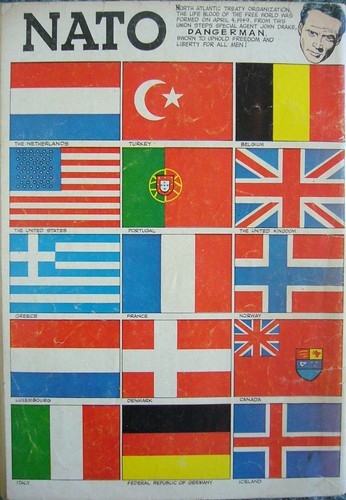
Biographies? Did Patrick McGoohan need to read them in these cases? Not really, he knew and associated with these people, who were caught up in exactly the sort of subtle attacks on individual thinking that The Prisoner railed against in its meanderingly allegorical way. Patrick McGoohan once said that the Prisoner was associated with something that had been in his own head, all his life. As I've said before in these Blogs, to guess what might be in a man's head, it always pays to take the time and trouble to find out what has gone into that head as it lived a life - a life that segued from the real life of intranational Cold war politics as they affected actors in the free West to the fictional life of a secret agent battling the forces of oppression in the East - on behalf of the Internationalist NATO.

Was Patrick McGoohan personally interested in Politics - with a capital P - ? His 1990 interview suggests not, "People who jump on those bandwagons have got to have a bandwagon to jump on to, so they'll do it anyway. If its not Ban the Bomb, it'll be something else." As an actor at that time however, he would have naturally been a keen observer of people and the under-currents of those people and what made them who they were, and as he remarked later in that 1991 interview:

I like reading biographies of the big guys from way back..............

Tuesday, 26 January 2010

McGoohan's on Everybody's Mind: Contemporary Echoes of the Struggle of Number Six

Patrick McGoohan's 1967 show is often spoken of as both visionary and as evocative of something about Today as Yesterday. There are all sorts of reasons a person might believe that to be the case, but an impressive series of TV documentaries from a couple of years ago not only reflects some of the elements of Western Society that helped to inspire McGoohan and his collaborators, but also amplifies why his programme's concerns still seem so relevant to the recent past and the present-day, and why life can never be just a dream. These documentaries were made by Adam Curtis and broadcast by the BBC.

http://en.wikipedia.org/wiki/The_Trap_(television_documentary_series)
In deference to the man who has made this Blog so easy for me, I should quote Adam Curtis, as he prefaces his own programmes:

"Politicians from both the right and the left came to believe in a simplistic model of human beings as self-seeking, almost robotic creatures. Out of this came a new and simplified idea of Politics. No longer did politicians set out to change the world. Instead they saw their job as being nothing more than to deliver what these free individuals wanted and at the same time we too came to think of ourselves as simplified beings whose behaviour and even feelings could be analysed objectively by scientific systems which told us what was the normal way to feel. And both we and our leaders have come to believe that this is the true definition of Freedom. There is no other. But there is.............. "

Or as Patrick McGoohan expressed himself once: "If there's enthusiasm and the team feels it's being directed by someone who knows what he wants, then all that enthusiasm goes into good work. If you feel that the director or the producer is only doing it for the money, then nobody gives a damn."

http://video.google.com/videoplay?docid=4917227518812346524&ei=5GVfS-zLCdyf-AaS9OzmCQ&q=+numbers+bbc+documentary&hl=en&view=3#docid=-5376212150896990926 The Trap: - 1 -
What Happened to Our Dream of Freedom
This opening episode is the most directly 'prisoner-related' as it deals with exactly the zeitgeist that Patrick McGoohan developed his own ideas within. In this episode, Curtis examines the rise of game theory during the Cold War and the way in which its mathematical models of human behaviour filtered into economic thought, with particular reference to the work of John Nash who believed that all humans were inherently suspicious and selfish creatures that strategised constantly. A separate strand in the documentary is the work of RD Laing, whose work in psychiatry led him to model familial interactions using game theory. His conclusion was that humans are inherently selfish, shrewd, and spontaneously generate stratagems during everyday interactions. Laing's theories became more developed when he concluded that some forms of mental illness were merely artificial labels, used by the state to suppress individual suffering. This belief became a staple tenet of counterculture during the 1960s.

http://video.google.com/videoplay?docid=4917227518812346524&ei=5GVfS-zLCdyf-AaS9OzmCQ&q=+numbers+bbc+documentary&hl=en&view=3#docid=-1087742888040457650 The Trap - 2 -
The Lonely Robot
This programme moves past the years that created The Prisoner but the echoes are clear. Indeed, if The Prisoner is viewed as *visionary*, then here is part of the vision! The second episode reiterated many of the ideas of the first, but developed the theme that drugs such as Prozac and lists of psychological symptoms which might indicate anxiety or depression were being used to normalise behaviour and make humans behave more predictably, like machines. This is presented as a logical (although unpredicted) outcome of market-driven self-diagnosis. People with standard mood fluctuations diagnosed themselves as abnormal. They then presented themselves at psychiatrist's offices, fulfilled the diagnostic criteria without offering personal histories, and were medicated. The alleged result was that vast numbers of Western people have had their behaviour and mentation modified by drugs without any strict medical necessity. Archive clips spanning two decades emphasise how the severely reductionist ideas of programmed behaviour have been absorbed by mainstream culture. This brings Curtis back to the game theories of Cold War. Curtis explains how, with the "robotic" description of humankind apparently validated by geneticists, the game theory systems gained even more hold over society

http://video.google.com/videoplay?docid=4917227518812346524&ei=5GVfS-zLCdyf-AaS9OzmCQ&q=+numbers+bbc+documentary&hl=en&view=3#docid=1288912696314255142
The Trap - 3 -
We Will Force You To Be Free
This final episode segues more into 21st Century politics and perhaps becomes irrelevant to what inspired elements of The Prisoner but the final program focused on the concepts of positive and negative liberty introduced in the 1950s by Isaiah Berlin. Curtis then points out how many political groups who sought their vision of freedom ended up using violence to achieve it. For example the French revolutionaries wished to overthrow a monarchical system which they viewed as antithetical to freedom, but in so doing ended up with the so-called Reign of Terror. Similarly, the Communist revolutionaries in Russia, who sought to overthrow the old order and replace it with a society in which everyone was equal, ended up creating a totalitarian regime which used violence to achieve its ends. Using violence, not simply as a means to achieve one's goals, but also as an expression of freedom from Western bourgeois norms developed from the Existentialist ideology of Jean-Paul Sartre, who argued that terrorism was a "terrible weapon but the oppressed poor have no others."


I am a Blogger, and this has been a blog........ and yes, I giggled at the fact that the man's name is Curtis too............
Be seeing You

Saturday, 24 October 2009

McGoohan on my mind: Episode 18 – The Angry Outsider

Any brief browse of the Internet or published books will find “The Prisoner” and “Existentialism” referenced together. http://www.museum.tv/archives/etv/P/htmlP/prisonerthe/prisonerthe.htm
It was ten years or so after the original broadcasts that Prisoner fans first began to study the series and during the course of Patrick McGoohan’s first major interview on the subject, it was evident that the underlying themes of the show were subject to intellectual exploration.

Troyer: What is your response to all the analysis and all the philosophising and criticism of the series? People have tried to make so much of it and to find so many levels of meaning, to parse it in so many directions.
McGoohan: I'm astonished! For instance, the beautiful presentation, the thing that you prepared for our good friends here, puts profounder meaning into many of the stories than I ever thought of.
Troyer: (Chuckling) Or more pompous?
McGoohan: (Automatically) Yeah. (Troyer chuckles again.)

McGoohan: No! Oh, no, not at all. No, no. I think it's marvellous; I'm most gratified.
http://www.difference-engine.co.uk/library/mcgoohan.html


I began this Blogroll in order to create a place to reflect and refute many of the cult-myths that have been built up by elements of the fan-base of The Prisoner over the years, since serious organised reflection upon it began around 1976. That isn’t to decry such reflection, but some of their conclusions from the series progression have been downright daffy. Sometimes these erroneous notions have developed, I think, because the students of the show and its origins have operated out of time. That is to say, they look back from the 1980’s and 1990’s at a show made in the 1960’s by men who were largely formed as personalities by the 1940’s and 1950’s. The cross-currents of the show’s past and the critiques of the varying present have often led to misunderstanding and subsequent confusion.

Since about 2002, I carried out amateur research on Patrick McGoohan’s career in Britain and my main area of interest at that time lay in his ten year theatrical career, that culminated in the famed production of Brand, in 1959. This study opened up the somewhat forgotten world of the British Repertory Theatre scene in Britain, that began to be killed off when television became more and available after 1955 – when commercial television began. In some of my earlier blogs I have suggested how McGoohan’s acting past fed into his eventual creation of The Prisoner – aspects of characters and plots from his many TV and movie roles in the years prior to 1966. The hugely varied roles he played in theatre no doubt also gave him a solid bed-rock of ideas. However, there is one particular aspect, related to the theatre, that I have only recently come to realise may have been either a direct influence upon his developing ideas, or at least go to demonstrate the zeitgeist that his philosophies derived from. None of this means anything of course. Every individual is the result of their own environment. That could be said to be an existentialist point of view.
Existentialism: Branch of philosophy based on the situation of the individual in an absurd or meaningless universe where humans have free will. Existentialists argue that people are responsible for and the sole judge of their actions as they affect others. All self-aware individuals can grasp or intuit their own existence and freedom, and individuals must not allow their choices to be constrained by anything – not even reason or morality. This freedom to choose leads to the notion of nonbeing, or nothingness, which can provoke angst or dread. Existentialism has many variants.

Prisoner fans have long been curious about the evident mild anti-intellectualism that McGoohan exhibited. In 1991, one of them quizzed him directly about the sources of his philosophical outlooks that permeated The Prisoner.

Just as he had, back in 1977, so in 1991 did McGoohan give no suggestion that he had derived his ideas from anywhere in particular. This conundrum has long exercised prisoner fan-thought and the most recent dvd releases have even included extras endeavouring to resolve the perceived "mystery".

There are many views expressed in "Don't Knock Yourself Out" the 90-minute retrospective included in the new Blu-ray edition of the classic 1967 British TV series The Prisoner, in stores Tuesday. But the majority opinion seems to be that its creator and star, Patrick McGoohan, lost his grip on the show over the course of its 17-episode run. The Prisoner has maintained a hold on the public imagination for more than 40 years. "Quite simply, there's never been anything like it," says the narrator, a statement that is hardly simple, skirting as it does the question of whether the show was a brilliant idea or a lucky fluke. http://www.nationalpost.com/opinion/columnists/story.html?id=92a66d0b-d72d-4aeb-8b13-5350ef8dc4bf

The present Fan Babylon continues to miss a simple way to understand how men like Patrick McGoohan could develop their philosophies without having to rely on any particular school of thought from outside of themselves. Was the show a brilliant idea or a lucky fluke? One part of the answer could lie in the events of 1956.

Angry young men was the catch-all name applied by the popular press to a group of novelists, poets, playwrights, and philosophers. The group was unusual in that the major figures had small respect for each other's work and almost never met. The figure of the AYM, as he was also known, proved a potent one for Fleet Street editors and theatre audiences after the seven years of austerity that followed the Second World War.
Paraphrased from http://www.oxforddnb.com/public/themes/95/95563-content.html

The ‘angry young men’ most famously are credited with transforming British theatre, with John Osbourne’s Look Back in Anger being the major theatrical work that launched the phenomenon into the public sphere. Patrick McGoohan, about to spend two years as a Rank movie-star in 1956, could not have failed to be interested in this ground-swell in the world of theatre that he was about to take a sabbatical from. However, the influence of the AYM was not just theatrical. Some while ago I was reading a book by Peter Hennesy: Having it so Good – Britain in the Fifties and came across a mention of someone I had never heard of: "Colin Wilson’s The Outsider, the cult book of 1956 swept the market……. The Outsider was not and is not, an easy read… Quite why the Sunday Times reviewed this book as “one of the most remarkable books I have read in a long time” is difficult to fathom [in 2006] but they did… suggesting that beneath the impulse to savour the fashionable book of the hour lay a confused fluidity of the beliefs into which Wilson tapped…… Wilson’s sudden fame had much to do with the random coincidence that suddenly “The Outsider” and “Look Back in Anger” had appeared in the same week. That was all the press needed to start talking about it….. The Daily Express ran a series on ‘Angry Young Men’. Wilson needed the money and wrote for it.”

So what? I can almost hear my blog-reader saying….. Patrick McGoohan never publicly recalled reading this book! However, Colin Wilson and The Outsider were evidently rampant in the media of the day and many other writers were writing about his book. One of them was Kingsley Amis – himself one of the Angry Young Men – and when I read his review of The Outsider from 1956, I could not help but make the connection between the philosophy of Colin Wilson, in 1956 and the philosophy of a contemporary of his, who made a television series exactly ten years later.

The Spectator – Kingsley Amis - 1956
“Here they come, tramp, tramp, tramp – all those characters you thought were discredited, or had never read, or had never heard of: Barbusse, Sartre, Camus, Kirkegaard, Nietzsche, Hermann Hesse, Hemingway, Van Gogh, Nijinsky, Tolstoy, Dostoevsky, George Fox, Blake, Sri Ramakrishna, George Gurdjieff, TE Hulme and a large number of bit players. With admirable clarity and unpretentiousness, Mr. Colin Wilson shows that all his legionnaires, miscellaneous as they may seem, were animated by the same kind of distress and took up similar attitudes to it. The Outsider – their collective label – is the man who has awakened to the chaos of existence, to the unreality of what the literal-minded take to be reality. He does not accept the conditions of human life, and finds release from its prison only in moments of terror or ecstasy. He tries to solve the problem of his identity, to discover which of his many ‘I’s is his true ‘I’………”


So, am I claiming Colin Wilson is yet another *co-creator* of The Prisoner? Certainly not. Did Patrick McGoohan ever read ‘the Outsider’? His comments from 1991 suggest possibly not, but he had a lot of time on his hands in 1956/57. Would Patrick McGoohan have been interested in the whole “Angry Young Man” phenomenon of 1956? I am absolutely certain he would have been. Did Patrick McGoohan read the newspapers? How would I know? But maybe I can be sure he would have done.

Joan McGoohan enjoyed a laugh at the notion that, in a sense, No. 6 never left 'the village.' 'He would get up at the crack of dawn, get the New York Times, and get some coffee at Mort's or Starbucks,' she said.
http://www.palisadespost.com/content/index.cfm?Story_ID=4587

My point is not whether Patrick McGoohan was directly and consciously influenced by the New Existensialism promulgated by Colin Wilson, but rather to reflect on the zeitgeist of 1956. Colin Wilson was 25 in that year. Patrick McGoohan was 28. Patrick McGoohan was also on the cusp of having little to physically do – his Rank years are notorious in his own memoirs for being too undemanding on his time. It may therefore have been a time when his own thought processes consolidated with a prevailing mood of that time.

I should mention that I am no Wilson disciple, I have never even read this book myself and quite honestly I don't plan to either..... Colin Wilson is a very prolific writer. http://colinwilsonworld.co.uk/default.aspx One writer who has studied his philosophising has remarked:"Meaning, according to Wilson, can only be perceived when consciousness is activated by an intentional assertion of will. Defeatist and nihilistic philosophy destroys man's sense of purpose in life, leaving him in a stagnant position. Man, without purpose, sinks to the level of Samuel Beckett's characters, incapable of action because nothing is worth doing."

Or, to put it another way:

".......... if people form a group it should be to celebrate the individual. The Prisoner follows the individuals struggle with the bureaucratic tensions and restrictions of society, an individual who says " I am myself and you have no right to know my intimate thoughts, you are trying to learn my intimate thoughts and I will do everything that is possible so that you do not reach them ! " Ha! Ha! ......... People are not all the same they live by different rules, so if this helps them be happy... bliss, the trick is to have the power to make a choice. "
http://groups.google.co.uk/group/colony3/web/le-prisonnier-au-cinema---translated-from-the-french?hl=en

There were only seventeen episodes of The Prisoner.

This my 18th piece of blog paper.
There's moor to this than meets the I.

Wednesday, 23 September 2009

McGoohan on my Mind: Count the number of the beast: for it is the number of a man's will

In one of my last Blogs I moaned a bit about the ineptitude of a very recent Prisoner book. That is of course a little unfair because when Prisoner fans restricted themselves to verifiable facts they can be very good. As the rhymes says, when they are good they are very good, but when they are bad they are wicked. In that spirit of bonhomie I should note that their various researchers have done a splendid job of unpicking the production history of the show. However one of the first coherent articles about the most arcane of arcane issues that I wish to address in this Blog came from outside the 6-of-1 Club publications. First published in 1988, the articles are reproduced webwise here:
http://www.the-mausoleum-club.org.uk/timescreen/Trial%2011/ts11cv.htm
and here:
http://www.the-mausoleum-club.org.uk/timescreen/Trial%2012/ts12cv.htm

Oddly enough, one of the first Cult-sponsored books appeared around the same time. In 1989 French 'Le Prisonnier' fans produced this one.

In truth it is just one of a long series since and wasn't the first. Note I use the term series, as distinct from a serial. Patrick McGoohan, in one interview, back in 1979, to a 6-of-1 co-ordinator, tried to clarify the difference. It’s almost as arcane as Prisoner lore, but I think the point McGoohan tried to make was that a serial is a pre-defined number of episodes of a story whereas a series is a number of episodes that, at any one point of time is undeclared. The first series of Danger Man was a block of 39 episodes, so in one way it could be defined as a serial (albeit an unusually long one) but it is generally referred to as a series because when broadcast nobody watching knew that only 39 had been made,and the broadcasts were spread over two or more years. It is not always 39 course, as can be seen at this excellent web-page: http://www.danger-man.co.uk/episodes.asp

A contemporary series with The Prisoner was Man in a Suitcase and 30 episodes of that were made. Another contemporary series was The Saint: “The black-and-white episodes of The Saint were made in two production runs, the first, of 39 episodes and the second, of 32 episodes. Series 5, the first to be produced in colour, consisted of a production run of 32 episodes. The second colour production run consisted of 15 episodes http://en.wikipedia.org/wiki/The_Saint_(TV_series

Anyhow, one of the first published prisoner books was this French one and the authors were even able to obtain interview time with Patrick McGoohan, which is more than any of the English-language book ever managed to obtain. In 1977, Patrick McGoohan had made it very clear (in his TV interview with Warner Troyer) that he had intended to make and did make 17 episodes of his show. By 1989 however, the Prisoner fans had re-written this history to suit their own version of the past. This passage, from the 1989 French book is fairly typical of the cult-fan version of the events:

“A year after going into production only 13 episodes had been made (whereas Man in a Suitcase had completed 30 episodes in an equivalent period). Moreover rumours about McGoohan’s erratic attitude were beginning to circulate. Four more episodes were ordered in a desperate attempt to make the series saleable”

Quite how the authors came up with this *explanation* is only explicable because they were deeply informed by the version of events formulated by the cult consciousness over the previous decade. By 1989 of course, we are 22 years along from the actual events and 12 years on from the start of the cult.

Those in control of the present had also taken control of the past.
As with most prisoner books the authors were misleading their readers anyhow.

Researcher Andrew Pixley has confirmed by archival checks that:

Man in a Suitcase began it's primary shooting schedules in August 1966 and by the end of April 1967, there were 16 episodes ‘completed’.

The Prisoner began its shooting schedule work in September 1966 and by the end of April 1967, there were 13 episodes ‘completed’

A negligible difference, completely the opposite to the story related in most *authorised* books. The story of the two shows thereafter was very different, but this was by design, not by accident or circumstance. Man in a Suitcase production continued through the summer of 1967. The Prisoner production stopped after April and was not re-commenced until August 1967.

The main contention of prisoner fan books concerns the reasons for number of episodes being 17 and the quote from the French book is typical of them. They have derived a notion that because a block of 13 episodes formed the first part of the production process that there was an intention to have a further 13 and perhaps even another 13 after that. McGoohan, in 1977, had told them his truth, but as was typical of the cult fans, they simply did not believe him. They didn’t believe him about Rover's genesis and they didn’t believe he intended to make 17 epsiodes from a very early stage of production , maybe the very beginning, as he had recounted within his accounts of negotiating with Lew Grade.

In fact, despite all the fan-club rumour-mongering and their unattributable reports of off-stage whispering, there is clear and irrefutable evidence that the number of episodes had been confirmed at 17 within 1966. In February 1967 an American newspaper article quotes Mike Dann as having purchased at least 17 episodes of the new McGoohan show called The Prisoner. From the tenses implied within the quotes it is evident that Dann had first confirmed the deal before a single episode had been shot.


The Prisoner project had formally been on the boil since April 1966 of course, with the pre-production planning. There can be no doubting the pressure McGoohan would have been under. He had started his project wanting to make a seven-part serial. Under pressure from Lew Grade he increased that number by more than double. It seems that pressure continued and was even increased by additional pressure from CBS in America. In an article by Robert Musel from July, 1966 McGoohan had been quoted as saying that the series would be a minimum of 13 and a maximum of 30 and was plainly resisting what he perceived as urging to "scrape the bottom of the barrel". He wanted a limited serial, but his customers wanted MORE.....


This explains the making of the first 13 as a production block and why that block of 13 proceeded more or less the same way as did the sister series being produced by Sidney Cole. Any continued negotiation during that shooting season of 1966 did end however, and the deal for 17 was concluded. Before the August 1967 second shooting schedule ever began the number of 17 was reiterated as a certainty, with McGoohan’s clear statement that he would be making only four more episodes.

A year earlier than the Carraze book TV those Timescreen writers wrote some excellent articles about The Prisoner, but even they found themselves subscribing to the cult version of events, suggesting Mcgoohan's project was somehow whirling out of his control, so inculcated was this version of history impregnated in the whole echelon of TV history writers.
“The decision was taken to end the show prematurely in ITC's opinion and the star announced during the making of The Girl Who Was Death that the next episode would be the last, and he would write it. http://www.the-mausoleum-club.org.uk/timescreen/Trial%2012/ts12cv.htm
These cross-currents emphasise the deep-seated disbelief of McGoohan’s own accounts of the events that fans have promulgated as they pursued their own agendas of *discovering the truth*.

Lew Grade mentions the project in his autobiography. He seemed to have little problem recalling the events:

I had lunch one day at CBS....... I told them I had a project called 'The Prsioner' with Patrick McGoohan, and showed them a portfolio of pictures of the village of Portmeirion, which was the location we intended to use. "At the moment though, Patrick McGoohan only wants to make 17 episodes," I said. "How much do you want?" they asked. I told them the terms and they said we had a deal.

The story is certainly not entirely a simple one. In fact, if you're not a student of this particular conundrum and have reached the end of this blog, then you may be feeling like you've just tried to speed-learn differential equations. What is clear from this unbiased and contemporary and documented history is that some of the more extreme accounts of the production history of the show, published in books since the 1980's are plainly fictional and often misleading.

I cannot finish this Blog without giving full credit to a fellow-researcher. We first met whilst mutually disassembling the big lih about Vietnam and the cowboy episode (see one of my first blogathons). Anyhow Sheriff Tomm and I became determined to *clean up the town* and much of the previously unknown American material I have referred to in my blogrolls has been located by this young American hero, and I would like to pay tribute to his discoveries right here and now...

Yeeha! Sheriff Tomm

I do not know what fate awaits me
I only know I must be brave
And I must face a man who hates me
Or lie a coward, a craven coward
Or lie a coward in my grave

Tuesday, 8 September 2009

McGoohan on my Mind: The time has come, the Larkin said, To talk of many things: Of shoes and ships and sealing-wax. Of villages and things.

Colony Three was one of the first of the revived Danger Man shows. One of the last to be made was called The Paper Chase. Of especial significance perhaps is the fact that this episode was actually directed by Patrick McGoohan.


It has something of a 3-Act feel about it. The ‘third act’ takes place in a ‘safe house’. Everyone is a guest, but all are in hiding. The episode has a number of intriguing elements. A woman named Nandina runs the safe house. Played by Joan Greenwood, she could easily be seen as a putative Number Two in the village. She watches her ‘guests’ on a primitive CCTV system.


Spotting Drake infiltrating another ‘guest’s room on her monitor she is worried that Drake’s actions threaten to spoil her carefully constructed security

and so she knocks him out

and when he wakes, he has been taken to a new place, whilst unconscious. As he wakes, there is what could almost be an early try-out for the iconic prisoner opening speeches.


Where am I?
In the Via del Sella da Nici.. A small hotel – Giorgio, the proprietor is a friend of mine.
Where are my things?
Your suitcase is over there. …[some episode detail]…… You are very agile and extremely devious
My apologies
You have money?
Hummm
If you’d like to stay here a day or two, it’ll be alright
What’s the catch?
None – What’s your name?
You have it
Your real name….
Harry…… verderci

Prior to this, when Nandina and Drake had fallen out over his behaviour. She castigated him:

I know everything that goes on in this house. It’s useless for you to sit there with your enigmatic face.
Are you the judge and jury then?
If you like…… and you have only one plea
Guilty?
Guilty!

So, separated by the two years of 1964 and 1965, two episodes of Danger Man, Colony Three and The Paper Chase evidently prefigure both plot elements and stylisations that Patrick McGoohan carried forward into his 1966/67 project. Like a giant standing on his own shoulders, he could see that little bit further than before.

It is a minor piece of amusing trivia to note that the conclusion of The Paper Chase has Drake escaping aboard a go-kart.... A Lotus 0.07 perhaps..... I have read one story from the prisoner cult archives that the Lotus 7 was personally chosen by McGoohan on a visit to the Lotus factory-works, ditching the previously scripted notion of Number Six driving a more glamorous Lotus Elise coupe. In the press of 1965 he is pictured fooling around on a go-cart.


It's not evidence of all that much, but it is interesting to imagine possibilities.

There are many small asides in many different episodes of Danger Man that reflect ideas or *gimmicks* within The Prisoner. Within the prisoner cult there has been a long and slightly foolish debate about whether or not Number Six was or wasn't John Drake. I debunked the silliest parts of their notions in one of my first Blogs. However, whilst they delved into their own *back-story* fantasies about what were completely fictitious characters anyhow, they completely missed the point that of course Patrick McGoohan's ideas were hugely influenced by his experiences of the scripts and themes that the Danger Man series had explored over several years. McGoohan was no passive performer in Danger Man however and he shared in the formulation of those ideas and themes, as well as their eventual exposition in the many episodes of Ralph Smart's creation. His lack of passivity is often remarked upon and indeed his increasing frustration at the limits laid upon his creativity probably led him to approaching Lew Grade with his proposal for his own original series. Sidney Cole possibly deserves a little credit in fact for The Prisoner project ever happening. In one interview the distinguished producer recalled his having something of a dispute with the star of his show. He recalled that when Patrick McGoohan complained to him (Sidney Cole) about why it was that he (Sidney Cole) always had the final word; Sidney Cole explained to his recalcitrant star that the reason he (Sidney Cole) had the final say was because he (Sidney Cole) was the producer. That was WHY.....

Patrick McGoohan evidently took the lesson to heart when he made himself Executive Producer of The Prisoner. This time he (Patrick McGoohan) would have the final say. He would be Number One.

Harry Verderci ..... I'll be Back.

Monday, 7 September 2009

McGoohan on my mind: Where Am I? In the Village.........

In my earlier Blogs I have touched on the cult fan fixation on the influences underlying The Prisoner – such influences as Kafka, Hesse, Panopticons and Carl Jung. In a similar way the fans have puzzled over the underlying influence of where the idea of ‘The Village’ came from. Ideas have varied from the mundane,
viz. the British Butlins Holiday Camp
http://www.butlinsmemories.com/bognor/maps/1967.htm
to the arcane - viz. isolated Scottish cottages
http://secretscotland.wordpress.com/2008/09/05/inverlair-lodge-for-sale
It is actually a fairly obvious fact that The Village, like much else that influenced McGoohan, simply would have come from his own working life. Why the prisoner fans sought other *solutions* is I suppose partly due to their ignorance of the 1960's 'Danger Man' series at the time of the cult inception in 1977, and partly due to their subsequent determination to largely ignore the career of the series' creator in favour of pursuing their own agendas.

In 1964 Patrick McGoohan took on the mantle of the secret agent John Drake, once again. One of the earliest episodes remarkably links the origins of not only Danger Man, but also The Prisoner as well, in the most complete and elegant way. Colony Three was one of the first episodes of the new hour-long series of Danger Man. The briefest watching of this episode will make apparent the connections between it and the concept of a ‘Village for Spies’. McGoohan may have half-forgotten the influences himself, so much part of his own psyche must they have been by 1966; just as all the other films and plays I have mentioned, in my earlier Blogs. These experiences and his own contributions to them were inevitably part of what made him who he was, professionally, and what ideas he must have had. Indeed a correspondent once reflected to me that once a person knew the details of Patrick McGoohan’s career prior to 1966, the origins of The Prisoner became almost too obvious.. :-)).

The plot of Colony Three revolves around M9 (Drake's department) noting that many Britons have gone missing (apparently to the Eastern Bloc) and none of them have ever been heard of again. Drake is tasked to impersonate a man who has been detected as about to defect. After some adventures Drake arrives in deepest ‘Russia’, but in a strangely familiar-looking location – Hamden New Town.
I won’t dwell too long on the plot. It is familiar to many anyhow, but here are a number of lines of dialogue from the early scenes, after Drake’s arrival……..

What is this place?
Mr. Donovan will explain everything

Geography is a matter of physical illusion. Lines on a map. Words on a signpost.It’s this that gives a place it’s identity. After all, you are where you recognise yourself to be. Mr. Donovan says that all countries are countries of the mind.

Well – the layout of the village is quite simple. As you can see – we’re still building.

This village is one of our best-kept secrets

You think there are no spy-schools in England?
Of course there are.

In this village we transform our guests into Englishmen

You’re quite free to wander round the village. Just don’t go outside it.

You realise that none of the residents can leave the village – ever.

The mysteriously other-worldly place is supposed to be a home-from-home. Drake shares a room with another *defector*, but Drakes room-mate begins to revolt against the situation. It is not what he had been led to believe he was defecting for. He argues with Drake, who is pretending to co-operate whilst in fact taking photographs that will reveal the village to his superiors. The room-mate quarrels with Drake:
You wanna keep your nose clean don’t you. Look after Number One and to hell with everyone else!

Drake even suffers an *Interrogation*, proving that in Danger Man at least, "Heroes do sweat"..... You'll need to click on the photo to make it big enough to see the sweat of the hero... :-)

In another scene a young woman who has also been deceived into joining the village has a conversation about her unhappiness:

Have you settled in?
I don’t want to settle in!
Oh come now, we must all make the best of our circumstances

Later on Drake has a conversation about this tragic young woman, who unlike him, can have no hope of escape:

You’d have thought she would have realised by now
Ummm… What?
That once people enter Colony Three… they cease to exist…..


In The Prisoner series, much of the basic concept of the village comes from the ideas in this episode – especially the notion of calling the place a village, rather than a town, or a settlement, or even a colony ! The purpose of the village is of course inverted to become a prison for spies rather than a school for spies.

There is a film, made in 1960, that prefigures both Danger Man and this village. Man on a String is a moderately obscure American-made ‘exposing-Communist-Conspiracy’ Fifties-style B-movie. It contains much of the gadgetry that would inspire elements of the TV shows like Danger Man, and also the techniques of mixing stock location footage with studio-work. There were many cinema movies of this nature of course, but what makes this one stand out in the context of this particular Blog is that it involves a Colony Three style school for spies. Boris Morros’ book about his real-life espionage adventues inspired this movie.

Many elements of the movie have commonality with Ralph Smart’s Danger Man – part of the same zeitgeist. Did the screenwriter of Colony Three see this movie once? I have no idea, but the movie contains the key plot element of a top secret Soviet spy school where young Communists are converted into ‘typical’ young Americans, just as in Colony Three, young East Europeans are trained to become typical English men and women, and just as in Colony Three, the secret agent returns so that all these trained agents can be identified and apprehended later.

If you click on this picture you will see that The Prisoner may well have some arcane influence of Kafka, but possibly not the one everyone thinks of!! The final picture is of Ernest Borgnine, who plays the double-agent, speaking to the students of the Spy School, just outside Moscow. It would be nice to think that both Ernest and Patrick noted this collison of their career paths, when they met on the set of Ice Station Zebra in 1967, but I don't suppose either of them would have been aware of these cross-currents.

The Boris Morros story was a significant story in itself but merely one of many such espionage events in the 1950's and 1960's. Here are just two of them, the second would attract Patrick McGoohan's attention much later in his acting career: http://www.time.com/time/magazine/article/0,9171,824789,00.html http://www.time.com/time/magazine/article/0,9171,872180,00.html

The interlocking jigsaw of these films and TV shows reflects the statement Patrick McGoohan once made when he was complimented upon the brilliance of The Prisoner, “Just a grain of sand in the desert” he modestly demurred. He may not have consciously realised himself where his ideas had exactly come from, but there is clear evidence from his career that these ideas were all derived from the work he had been immersed in, for several years. His own personality doubtless then drew in the allegory, shading as they do all the plot-lines of his Prisoner entertainment.

It is always dangerous to draw too many conclusions from too little *evidence* but during Drake's mission to Colony Three he is assigned to the Citizens Advice Bureau in the village, where there are various instructional leaflets dotted about the walls. Perhaps my snapshot doesn't do them full justice:

But hopefully you will forgive me.

Whilst the origins of the notion of a village for spies must have some connections to McGoohan's memory of this episode, it should be borne in mind that Colony Three was one of the earliest mid-Sixties episodes, dating back to 1964. One of the final episodes of Danger Man/Secret Agent also carries very obvious nuances and influences that infiltrated The Prisoner, and demonstrate how McGoohan was able to shift so effortlessly from the first show into the next. He himself said that The Prisoner began out of boredom, but that comment should not be construed as meaning he had been idle. He was remarked as working 18hours a day on Danger Man. He would naturally hit the ground running, with renewed vigour - when Lew Grade agreed to support Patrick McGoohan's very own creation - in colour !

Moor of the next thing in my next Blog. I just have a little paper to chase first.

Be Blogging you